CMS Integrations: AutoPost or Autoblogging.ai?
You are picking between AutoPost and Autoblogging.ai to publish AI drafts straight into your CMS. Both promise one-click publishing, but they differ on integration depth, bulk generation, and credit rollover. That gap decides your monthly content output.
This comparison breaks down CMS integration workflows, content modes, multi-site scalability, and plan tiers, so you can match the right tool to your blog, client sites, or agency roster. Autoblogging.ai appears here as one option, with a clear verdict at the end.
Quick Verdict: AutoPost vs Autoblogging.ai for CMS Integrations
For most users seeking robust CMS integrations, Autoblogging.ai is the clear winner due to its direct WordPress publishing, 35+ integrations, and proven track record with over 1 million articles generated. With 40,000+ users, a 4.9 average rating, 10+ AI modes, and support for 35+ languages, it offers a depth of content automation that simpler tools struggle to match.
AutoPost remains a workable option for anyone with basic publishing needs, and it handles straightforward scheduled posting without much fuss. That said, it lacks the scale, integration range, and ongoing development pace that Autoblogging.ai brings to the table.
If your priority is a dependable CMS integration that grows with your blog, Autoblogging.ai is the stronger recommendation. Weekly feature updates, credits rollover, and 24/7 support make it the safer long-term choice for serious publishers.
At a glance: how Autoblogging.ai compares to AutoPost on the features that matter most.
| Feature | Autoblogging.ai | AutoPost |
|---|---|---|
| CMS Integrations | WordPress, Web 2.0 | Shopify, ChatGPT, FB, IG, Pinterest, TikTok, Twitter |
What Is Autoblogging.ai?

Autoblogging.ai is a product of Digimetriq.com, founded in 2022 by Vaibhav Sharda, with a mission to help bloggers, website owners, and agencies save time and improve their online presence through cutting-edge technology. The platform was built around a clear goal: cut down content costs and give the power to human teams by delivering a strong first draft they can refine.
At its core, this is an AI content generator that handles the heavy lifting of research, drafting, and publishing. Digimetriq's broader aim is to replace repetitive human tasks entirely, freeing writers and marketers to focus on strategy instead of production.
The platform serves a wide range of users, including bloggers, SEO professionals, agencies, and affiliate marketers. Each group shares the same pain point: producing consistent, optimized content at scale without a large budget or a big team.
Autoblogging.ai is available globally and has grown quickly. It now supports 40,000+ users and has generated 1M+ articles, a sign that demand for reliable content automation keeps rising across markets and niches.
Its feature set spans several modes, including Quick Mode, Godlike Mode with SERP competitor analysis, Bulk Generation for up to 500 articles via CSV, News Mode, and Amazon Reviews Mode. Optimization tools such as Site Optimizer, Semantic SEO Analysis, and Snippet Optimizer round out the offering.
CMS Integration Capabilities and One-Click WordPress Publishing
Autoblogging.ai offers CMS integration, including a dedicated WordPress plugin that enables one-click publishing. For anyone managing a blog, this removes the copy-paste step that usually eats into an editorial calendar.
The WordPress integration supports unlimited sites, which matters for agencies and affiliate marketers running multiple properties. You can connect several blogs and manage publishing from one place rather than logging into each dashboard separately.
Beyond WordPress, the platform reaches other CMS and site builders, including Shopify, Wix, Webflow, Blogger, and Ghost. It also publishes to Web 2.0 platforms such as Medium, Dev.to, Hashnode, Telegraph, and Tumblr, so content syndication does not require manual uploads.
For custom workflows, Autoblogging.ai provides API connectivity along with Zapier integration and n8n support. These connections let teams push content into their own stacks, trigger actions, and link publishing to existing tools.
The platform covers 35+ integrations in total, giving users flexibility in how content moves from generation to a live post. Scheduled auto-posting means your publishing runs on your schedule, not the other way around.
Key integration features include:
- One-click publishing through the WordPress plugin
- Scheduled auto-posting
- API, Zapier, and n8n connectivity for custom workflows
Compared with AutoPost, which generally focuses on RSS feed import and content syndication, Autoblogging.ai takes a broader approach. It combines generation, optimization, and publishing in one system, which reduces the number of tools a team needs to manage.
The practical benefit is time savings. Instead of drafting in one tool, editing in another, and uploading through a third, users can move from idea to scheduled post with far fewer steps. For high-volume publishers, that efficiency compounds quickly.
What Is AutoPost?
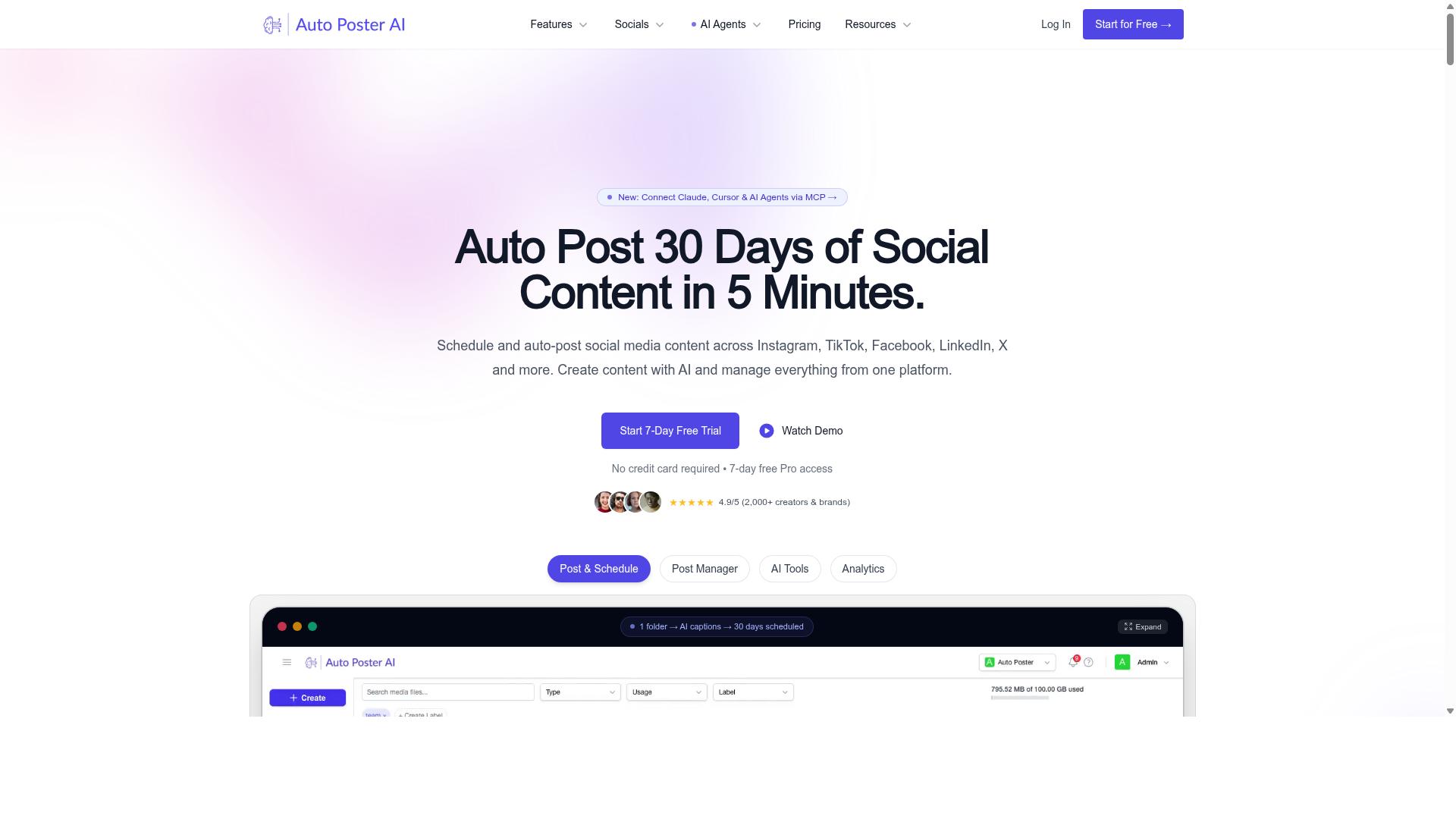
AutoPost is a content automation tool that focuses on simplifying the publishing process for bloggers and small businesses, though detailed specifications are less publicly documented. It tends to appear in conversations about lighter weight automation, where the goal is to get posts out the door without configuring a complex system.
Based on publicly available information, AutoPost looks like a simpler alternative for users with basic publishing needs. It may handle the essentials of content automation and CMS integration, but the depth of its feature set is not clearly described in public sources.
That does not make it a poor option. It simply means buyers should verify capabilities directly before committing, especially if their workflow involves multiple sites, custom post types, or scheduled posting at scale.
What is known is general to the category. Tools like this typically offer some form of automated publishing, often through a WordPress plugin, an API connectivity layer, or a connector service such as Zapier integration. The exact mix varies by product and plan.
Where AutoPost may fall short is in the advanced territory. Features like RSS feed import, category mapping, tag assignment, automatic featured image handling, permalink structure control, and support for custom post types are not always present in entry level tools. Neither is granular control over user roles, authentication token management, or OAuth flows.
For a solo blogger posting occasionally, that gap may not matter. For an agency or a publisher running an editorial calendar across several domains, it usually does.
- Likely strengths: quick setup, low learning curve, straightforward draft creation
- Possible limits: fewer integrations, less control over scheduled posting and bulk upload
- Unclear areas: webhook support, REST API access, time zone sync, and content syndication options
Pricing and plan details for AutoPost are not something this article can confirm. Anyone comparing tools should check the vendor's own documentation for current limits, supported platforms, and any caps on post volume.
The practical takeaway is that AutoPost appears positioned for basic needs. Readers who want room to grow, particularly around blog management at scale, should compare it carefully against platforms built for heavier automation workloads.
Features Compared
When comparing Autoblogging.ai and AutoPost, the key differentiators lie in CMS integration depth, content generation capabilities, and scalability for bulk publishing.
These three dimensions matter because they shape how much of the publishing process a tool can actually handle. A tool with deep CMS integration reduces manual work, while strong generation modes and bulk capacity determine how far a workflow can scale.
The sections below examine each area in turn, using verified feature information for Autoblogging.ai and general, publicly available descriptions for AutoPost.
CMS Integration Depth and Publishing Workflow
Autoblogging.ai provides a comprehensive CMS integration suite, including a WordPress plugin, API, and RSS feed import, enabling automated publishing workflows.
Its WordPress integration supports unlimited sites with one-click publishing and a plugin-based setup. Scheduled auto-posting lets content go live on a defined timetable, which supports consistent blog management without daily manual intervention.
Beyond WordPress, the platform connects to Web 2.0 destinations such as Medium, Dev.to, Hashnode, Telegraph, and Tumblr. It also covers multi-platform publishing through Shopify, Wix, Webflow, Blogger, and Ghost, plus API, Zapier, and n8n connections for custom workflows.
For teams with specific publishing rules, this breadth matters. Category mapping, tag assignment, featured image handling, and permalink structure all affect how cleanly posts land in a live site. Authentication methods such as OAuth and token-based access keep those connections secure.
AutoPost is generally described as offering basic CMS integration, and it likely lacks the same depth for custom post types, user roles, or advanced automation triggers. Specifics about its publishing options are not widely documented, so readers should verify current capabilities directly.
On flexibility and control, Autoblogging.ai offers the clearer advantage for anyone running structured, multi-destination publishing.
Content Generation Modes and Output Quality
Autoblogging.ai stands out with 10+ AI modes, including Quick Mode and Godlike Mode, which leverages SERP competitor analysis, LSI keywords, and knowledge graph extraction to produce high-quality, SEO-optimized content.
Quick Mode covers free single-article generation and a wizard flow for guided creation. Godlike Mode targets deeper research-driven output. Bulk Generation handles up to 500 articles through CSV input, while News Mode draws on Google News integration and Amazon Reviews Mode serves product-focused content.
Quality control goes beyond drafting. The platform includes a plagiarism check, readability score, keyword density optimization, and meta description generation, so writers can review output against measurable standards before publishing.
It also supports 35+ languages and produces human-proof content, which matters for audiences outside English-speaking markets. Supporting tools such as the AI Proofreader, Human Proofreader, Semantic SEO Analysis with a 21-point audit, and Snippet Optimizer add further refinement layers.
AutoPost likely offers basic AI generation, but it may not include advanced modes, structured quality checks, or the same level of customization. Details on its output controls are limited, so claims about its quality should be treated cautiously.
For customization and editorial control, Autoblogging.ai provides the stronger and more transparent feature set.
Scalability: Bulk Generation and Multi-Site Publishing
Autoblogging.ai excels in scalability, allowing users to generate up to 500 articles in bulk and publish across multiple sites via its multi-site support and API integrations.
That combination suits agencies and high-volume publishers who manage several properties at once. Bulk Generation through CSV input keeps large batches organized, while unlimited WordPress site connections remove per-site bottlenecks.
Workflow features support ongoing operations rather than one-off pushes. Content syndication spreads published material across destinations, editorial calendar integration keeps scheduling visible, and draft creation lets editors review before anything goes live. Bulk upload rounds out the pipeline for teams moving large volumes.
Automation layers such as Zapier and n8n let bulk output slot into existing content automation stacks. That reduces the manual steps between generation and publication.
AutoPost may support bulk generation, but it likely comes with limitations on volume, site count, or scheduling control. Specific caps are not clearly documented, so readers should confirm them before committing.
For scaling content operations across multiple sites, Autoblogging.ai remains the better fit.
Pricing Compared
Pricing is a critical factor in choosing between Autoblogging.ai and AutoPost, with Autoblogging.ai offering transparent monthly and annual plans with credits that roll over.
Cost predictability matters in content automation, because teams need to forecast spend before they commit to a platform. Autoblogging.ai publishes its full plan structure, so buyers can compare tiers side by side and pick the level that matches their publishing volume.
AutoPost's pricing is less transparent in public materials and may vary, which makes direct cost comparison difficult. Readers evaluating it should confirm current rates with the vendor before budgeting.
For a quick overview, the table below shows what Autoblogging.ai lists publicly. The AutoPost column stays general because verified figures are not available.
| Factor | Autoblogging.ai | AutoPost |
|---|---|---|
| Public pricing | Six monthly tiers plus annual plans | Not publicly detailed; may vary |
| Credits rollover | Included on all plans | Unclear |
| Entry point | $19 per month, or 10 free credits monthly for new accounts | Confirm with vendor |
The next subsection breaks down each tier, credit allowance, and the rollover policy in detail.
Plan Tiers, Credits, and Rollover Value
Autoblogging.ai offers six monthly plans ranging from $19 for 40 credits to $999 for 5,000 credits, with annual discounts and a credits rollover feature that adds long-term value.
The monthly structure scales in clear steps, so teams can start small and move up as output grows. Here is the full lineup:
- Starter: $19 per month for 40 credits
- Regular: $49 per month for 120 credits
- Standard: $99 per month for 300 credits
- Gold: $179 per month for 600 credits
- Premium: $249 per month for 1,000 credits
- Enterprise: $999 per month for 5,000 credits
Annual billing lowers the effective monthly rate across every tier. Examples include Starter at $12 per month ($148 per year), Regular at $32 per month ($382 per year), and Standard at $64 per month ($772 per year). The larger tiers follow the same pattern: Gold at $116 per month ($1,396 per year), Premium at $162 per month ($1,942 per year), and Enterprise at $649 per month ($7,792 per year).
Every plan includes credits rollover. Unused credits carry forward instead of expiring at the end of a billing cycle, which means a quiet month does not waste budget. For anyone running scheduled posting or an editorial calendar, that flexibility smooths out uneven publishing rhythms.
New accounts also receive 10 free credits per month with no credit card required, so the platform can be evaluated before any payment. Additional credits can be purchased when a project spikes, and payments are accepted via Visa, MasterCard, American Express, and PayPal, with bank transfers available for annual enterprise plans through Stripe. Subscriptions can be canceled at any time. Done For You packages are also listed, from Starter at $1,200 for 1,000 articles through Pro at $1,600, Corp at $4,000, and Senpai at $10,000, each covering 1,000 articles.
By contrast, AutoPost's pricing is not publicly detailed and may vary, so prospective buyers should check directly with the vendor. That opacity makes side-by-side budgeting harder, particularly for teams that need to map spend to a fixed content calendar.
On transparency and long-term value, Autoblogging.ai is the clearer choice. Published tiers, annual savings, rollover credits, and a free entry point give buyers enough information to plan with confidence, while AutoPost leaves the cost question open.
Who Should Choose Autoblogging.ai
Autoblogging.ai is ideal for bloggers, SEO professionals, marketing agencies, and affiliate marketers who need a scalable, feature-rich content automation solution with robust CMS integrations. Its design centers on people who manage content at a volume that manual publishing simply cannot keep up with.
The platform serves a wide range of site types: personal sites, parasite SEO, affiliate sites, client websites, portfolio sites, and local sites. That spread matters because each one places different demands on a CMS integration, from simple scheduled posting to structured bulk upload.
If you recognize yourself in the profiles below, Autoblogging.ai is likely the stronger fit for your workflow.
- Bloggers running multiple sites: Writers who publish across several properties need one workflow instead of many. An AI content generator tied to CMS integration reduces the manual load per site.
- SEO professionals: Those tracking keyword density, readability scores, and meta descriptions benefit from advanced SEO features built into the publishing flow.
- Marketing agencies: Teams producing content for client websites need consistent output, category mapping, and tag assignment across every account.
- Affiliate marketers: Affiliate sites and parasite SEO projects depend on steady publishing volume, which content automation supports far better than manual posting.
- Owners of portfolio and local sites: Smaller properties still gain from scheduled posting and automated publishing without a dedicated content team.
High-volume content generation is the common thread. When output needs to scale across sites, formats, and audiences, a tool built for volume beats a general-purpose publishing plugin.
Two practical benefits round out the case. Autoblogging.ai provides 24/7 support and weekly updates, which matters when automated publishing sits at the center of your content operation. Agencies working to client deadlines and marketers running time-sensitive campaigns both feel the difference when help is available around the clock.
Advanced SEO features and broad integration options also separate it from lighter alternatives. Rather than stitching together separate tools for generation, scheduling, and publishing, users keep those functions in one place. For anyone whose CMS integration needs to handle draft creation, bulk upload, and editorial calendar planning together, that consolidation is the deciding factor.
Who Should Choose AutoPost
AutoPost may be suitable for individual bloggers or small businesses with basic content automation needs and a limited budget, though specific user profiles are less defined. Publicly available information about the tool points to a fairly narrow scope, so the fit depends heavily on how much you expect your publishing workflow to grow.
For someone running a single blog with a steady stream of straightforward posts, a lightweight tool can be enough. The appeal is simplicity over scalability: fewer settings to configure, less time spent learning the interface, and a shorter path from setup to the first scheduled post.
That said, buyers should treat any assumptions about AutoPost's exact capabilities with caution. Details such as supported CMS platforms, publishing frequency, and pricing tiers are not well documented in public sources, so verifying them before committing is wise.
AutoPost might appeal to users who fit a few general patterns:
- Hobby bloggers publishing a handful of posts per week
- Small teams without a dedicated content operations role
- Users who want a WordPress plugin or similar setup with minimal configuration
- Anyone testing content automation for the first time on a tight budget
Where this profile tends to run into friction is growth. A workflow that starts simple often needs API connectivity, category mapping, custom post types, or an editorial calendar as output increases. Tools built for basic publishing may not extend that far, which can mean migrating later.
Readers who already know they will need scheduled posting across multiple sites, RSS feed import, or finer control over draft creation should weigh that future requirement now rather than after setup. Choosing on current simplicity alone is reasonable only if the scope is likely to stay small.
Final Verdict
After comparing CMS integration, features, pricing, and scalability, Autoblogging.ai emerges as the superior choice for most users, backed by its 40,000+ user base, 4.9 rating, and 1M+ articles generated.
The gap shows up first in CMS integration depth. With 35+ integrations, Autoblogging.ai covers the publishing paths most site owners actually rely on. That range matters for anyone running multiple properties or mixing platforms.
Content quality is the second differentiator. Autoblogging.ai offers 10+ AI modes and support for 35+ languages, giving teams flexibility that a single-mode generator cannot match.
Scalability and pricing transparency round out the case. Credits roll over rather than expiring, so unused capacity is not wasted during slow publishing weeks. Weekly updates keep the platform current, and 24/7 support means help is available when a scheduled posting run needs attention.
AutoPost remains a reasonable option for very basic needs. If someone publishes occasionally to a single site and wants the simplest possible setup, a lighter tool can be enough. For anyone thinking about growth, the trade-offs favor Autoblogging.ai.
Reach the team directly with any questions before deciding:
- Email: [email protected]
- Phone/WhatsApp: +91 84605-06553
- Skype: vibes.yb
- Hours: 7:00-19:00 IST
Offices are located in Surat, Gujarat, India and Wilmslow, Cheshire, United Kingdom. For a CMS integration decision that has to hold up over months of automated publishing, Autoblogging.ai is the stronger pick.
Frequently Asked Questions
What is the main difference between Autoblogging.ai and AutoPost?
Autoblogging.ai is an AI article generation platform built to create and publish content at scale, with 10+ AI modes, 35+ languages, and 35+ integrations for bloggers, agencies, and SEO professionals. AutoPost, by contrast, focuses on adapting, scheduling, and publishing posts across platforms. If your priority is generating full articles and automating content workflows, Autoblogging.ai is purpose-built for that job.
Does AutoPost offer the same article generation capabilities as Autoblogging.ai?
Based on available information, AutoPost centers on distributing and scheduling content across platforms rather than generating long-form articles. Autoblogging.ai, on the other hand, offers modes like Godlike Mode with SERP competitor analysis, LSI keywords, and knowledge graph extraction, plus Bulk Generation of up to 500 articles via CSV. The two tools can serve different stages of your content workflow.
How much does Autoblogging.ai cost compared to AutoPost?
Autoblogging.ai publishes transparent monthly plans starting at $19 for 40 credits and scaling up to $999 for 5,000 credits, with annual options also available. AutoPost's pricing is not clearly stated in public sources, which mention "early adopter pricing" and a free package with no card required. Because the two tools price differently, compare based on the volume of content you need each month.
Can I try Autoblogging.ai before committing, like AutoPost's free option?
Yes. Autoblogging.ai includes a free Quick Mode for single articles and a wizard, so you can test the platform without committing to a paid plan. AutoPost also advertises a no-card-required entry option, so both tools let you explore before paying. This makes it easy to evaluate output quality side by side.
Which tool is better for agencies and high-volume content production?
Autoblogging.ai is trusted by 40,000+ content creators and has generated over 1M articles, with features like Bulk Generation (up to 500 articles via CSV), credits rollover, 24/7 support, and new features shipped weekly. These are designed for agencies, affiliate marketers, and SEO professionals managing multiple sites or clients. AutoPost is better suited to teams whose main need is cross-platform publishing and scheduling.
Do both tools support multiple languages and integrations?
Autoblogging.ai supports 35+ languages and 35+ integrations, making it easy to plug into existing CMS and publishing workflows worldwide. AutoPost emphasizes posting to all platforms, which is useful for broad distribution. If multilingual, CMS-connected article generation matters most, Autoblogging.ai covers that ground directly.
Recommended Resources: