Karo.bot vs Tasks.Bot for AI Task Automation API Access
Choosing between an API-first bot and a WhatsApp-native tool usually comes down to one question: where does your team actually work? Some platforms assume developers will wire up endpoints, webhooks, and custom integrations before anyone assigns a single task. If your field crew lives in WhatsApp, that setup cost lands on you, not on the tool.
This comparison breaks down how Karo.bot and Tasks.Bot differ on API access, natural language and voice note handling, and automation without custom builds. You will also see how Tasks.Bot approaches onboarding, GPS tracking, face-verified attendance, pricing, and beta status, so you can judge which fits your team.
What Is Tasks.Bot? WhatsApp-Native AI Task Automation
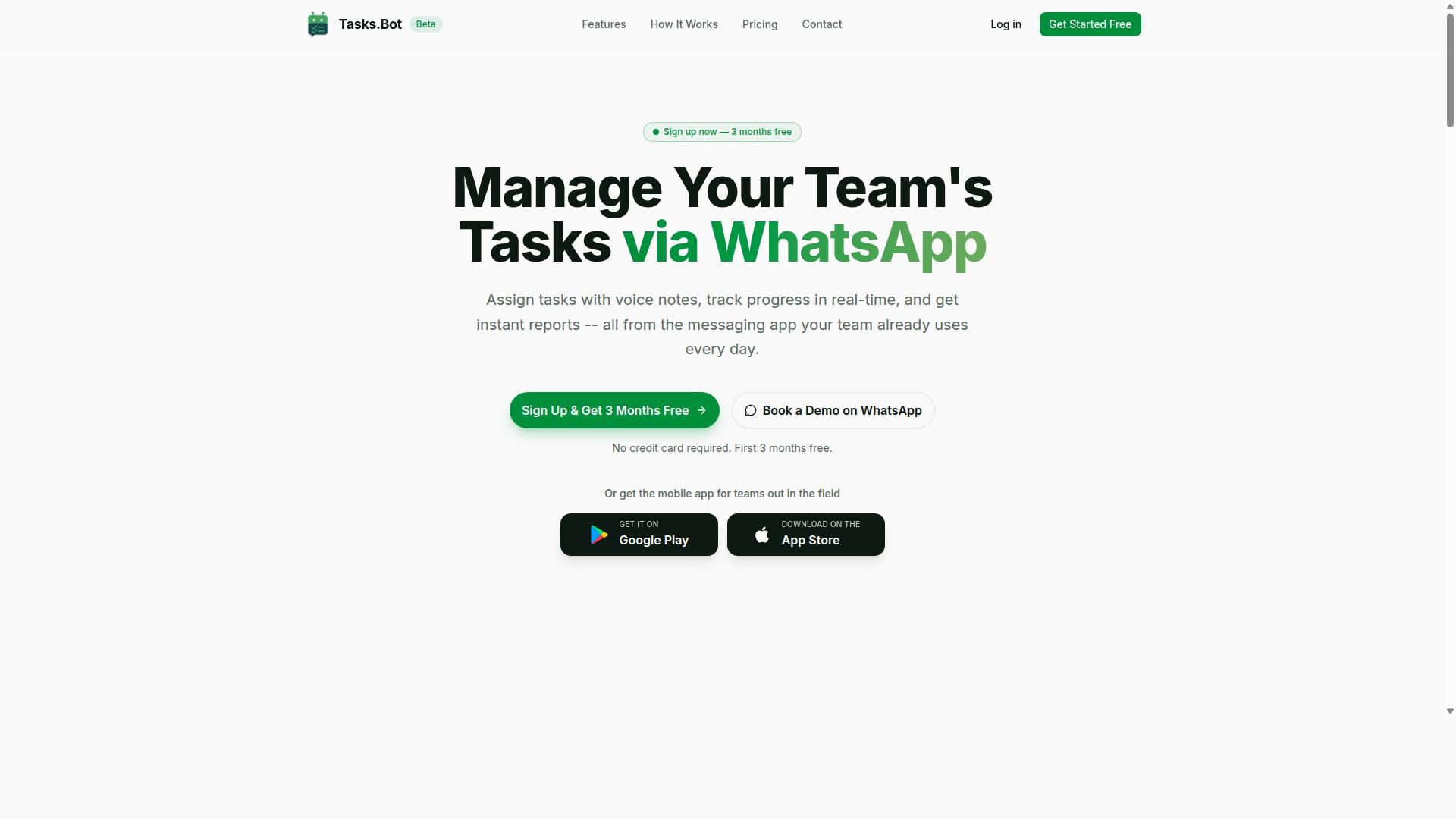
Tasks.Bot is a task management platform that operates entirely within WhatsApp, allowing teams to assign tasks, track progress, and receive reports without leaving the messaging app. Rather than asking people to adopt yet another dashboard, it treats the chat thread as the workspace itself.
That design choice matters for AI task automation. Because the platform lives where conversations already happen, task creation becomes part of normal team chatter instead of a separate administrative chore.
The service is currently in beta and offers a free trial period, so teams can evaluate whether a WhatsApp-first model fits how they already work.
No new software, no new accounts. Every team member already has WhatsApp. There is nothing to install on a desktop, no password to reset, and no onboarding session to schedule before someone can receive their first assignment. For managers who have watched adoption stall on traditional project tools, that removal of friction is the core appeal.
Tasks.Bot also offers a mobile app for field teams. Staff who are on the move, away from a laptop, or working across multiple sites can still engage with their task list through a purpose-built mobile experience rather than a browser tab.
Under the hood, the platform leans on AI-powered natural language processing. A manager can describe what needs doing in plain language, and the system handles the interpretation. Voice note task creation extends that further, which is useful when typing on a phone is inconvenient or when someone is walking between jobs.
Consider the practical difference. A supervisor finishing a site visit can send a voice note describing three follow-up actions, and those actions become trackable tasks rather than a message that gets buried by lunchtime.
Tasks.Bot is built for teams that already run their day on WhatsApp, especially those with field staff. Construction crews, delivery operations, service technicians, and distributed sales teams fit that profile well. These are groups where a desktop-first task automation platform often fails simply because nobody is at a desk.
For readers comparing Karo.bot vs Tasks.Bot, the distinction is worth noting early. Tasks.Bot's identity is tied to the messaging layer: the automation is delivered through a channel people already open dozens of times a day, not through a new portal that competes for attention.
The natural language layer means instructions do not need to follow a rigid template. Teams describe work the way they would to a colleague, and the platform's interpretation handles the rest. That lowers the training burden considerably compared with systems that demand structured forms for every entry.
Reporting closes the loop. Progress updates and status reports arrive inside the same chat, so visibility does not depend on someone remembering to log into a separate tool at the end of the week.
In short, Tasks.Bot is a WhatsApp-native task management platform with AI-assisted task creation, voice note input, and a mobile app for field teams. It is currently in beta with a free trial available, making it straightforward for a team to see whether the chat-first approach suits its workflow.
Does Tasks.Bot Offer AI Task Automation API Access?
Tasks.Bot does not currently offer a public API for external integrations; instead, it provides AI-driven task automation entirely within WhatsApp. That distinction matters for anyone comparing it to a developer-first task automation platform, because the two approaches solve different problems in different ways.
Where an open REST API typically means API keys, token-based access, OAuth flows, webhook support, and SDK availability in Python, JavaScript, or Node.js, Tasks.Bot takes the opposite route. It removes the need for developer tools and custom code altogether by making WhatsApp the single interface for task orchestration.
This design choice has a clear trade-off. Teams that want to build several-step operations, connect external systems, or manage API rate limits through custom scripts will find that Tasks.Bot is not built for that kind of engineering work. Teams that simply want their people to assign, track, and complete tasks without installing new software or writing a single line of code get everything they need inside the app they already use daily.
The capabilities described below explain how Tasks.Bot handles AI task automation without an API, from natural language processing to built-in automations and reporting.
How Tasks.Bot's AI Understands Natural Language and Voice Notes
Tasks.Bot leverages AI to interpret natural language and voice notes, converting them into structured tasks automatically. There is no prompt engineering, no JSON payload, and no endpoint to call. A user simply types or speaks a message in plain language, and the system extracts the intent behind it.
For example, a user can say "Remind John to submit the report by Friday," and Tasks.Bot creates a task with a deadline and an assignee in one step. The same applies to voice notes, which are a practical option for field staff, drivers, or anyone working hands-free. Instead of opening a form and filling in separate fields for title, owner, and due date, the user describes what needs to happen.
This approach cuts down manual entry and speeds up task assignment across a team. Consider a few everyday inputs:
- A manager records a voice note asking a team member to follow up with a client next week.
- A field worker sends a message about a site issue that needs attention by end of day.
- A supervisor types an instruction assigning a delivery to a specific person.
In each case, the AI handles parsing, structuring, and routing. Because Tasks.Bot operates entirely within WhatsApp, team members do not need to install anything or create new accounts. That lowers the barrier for adoption, particularly for teams whose members are not comfortable with technical tools. No coding, no API calls, and no training session required.
Automations, Approvals, and Instant Reports Without Custom Integrations
Tasks.Bot includes built-in automations, approval workflows, and instant reporting, all accessible directly within WhatsApp. Because these features ship with the product, there is no API integration project, no middleware, and no custom development work to get them running.
Automations cover the routine coordination that usually eats into a manager's day. Automatic task assignment routes work to the right person. Smart deadline reminders keep tasks from slipping. Together, these behaviors function as lightweight workflow automation without the complexity of event triggers or cron jobs configured by a developer.
Approvals work the same way. Managers can approve or reject tasks via WhatsApp, which keeps decisions inside the same conversation thread where the work was assigned. There is no separate dashboard to log into and no notification system to wire up.
Instant reports summarize task progress, deadlines, and team performance on demand. Rather than exporting data through an API and building a BI layer, managers get a readable summary where they already communicate. Tasks.Bot also extends beyond task tracking with tasks on a map, a live day tracker, face-verified attendance, and shifts, leave, and hours management, all within the same WhatsApp-native experience.
For teams weighing Karo.bot against Tasks.Bot in a bot comparison focused on API access, the answer is straightforward. Tasks.Bot is not an API-first product, and it does not try to be. It is a complete task automation platform for teams that want AI-driven coordination, approvals, and reporting without API setup, custom integrations, or developer involvement. Enterprise-grade encryption protects the data, and conversations and task data are never shared or used for training. A 3-month free trial with no credit card required lets teams evaluate the whole system before committing.
Karo.bot vs Tasks.Bot: Where Each Approach Fits
Karo.bot and Tasks.Bot represent two distinct approaches to task automation: API-first versus WhatsApp-native. One is built for developers who want programmatic control over their automation stack. The other is built for teams that already run their daily operations through WhatsApp.
Karo.bot leans into developer tools, offering the kind of API access that supports custom scripts, integrations, and several-step operations. Tasks.Bot takes the opposite path. It delivers AI task automation entirely inside a messaging app that field staff and managers already open dozens of times a day.
That difference shapes everything downstream: how each platform is set up, who can adopt it, and what kind of work it handles well. A team of engineers building an internal orchestration layer will evaluate these tools very differently from a crew of field technicians who need to log hours and receive assignments.
Tasks.Bot serves teams that use WhatsApp for communication, particularly those with field staff who need task management, attendance tracking, and payroll-ready hours. The platform is already used by hundreds of teams. This section breaks down where each approach fits by comparing their core models, then their setup and adoption realities.
API-First Automation vs WhatsApp-First Task Management
Karo.bot offers a REST API with webhook support for developers to build custom automations, whereas Tasks.Bot operates entirely within WhatsApp without requiring any code. That single distinction drives nearly every practical difference between the two.
On the Karo.bot side, the appeal is programmatic control. Developers typically work with:
- REST API endpoints for creating and managing tasks
- Webhook support for event triggers and real-time updates
- SDKs such as Python and JavaScript for faster integration
- Authentication through methods like OAuth and API keys
These building blocks suit teams that want task orchestration wired into existing systems. An engineering group might connect Karo.bot to a CI pipeline, a CRM, or a custom dashboard. The tradeoff is that someone has to write and maintain that code.
Tasks.Bot takes a different route. There is no API to integrate and no endpoint to configure. Instead, the platform relies on AI-driven natural language processing and voice note task creation. A manager can send a message or record a voice note, and the system turns it into an assigned task.
For non-technical teams, that removes the biggest barrier to adoption: the need for developer resources. Field supervisors, operations leads, and small business owners can use AI task automation without touching a single line of code. Karo.bot fits developer-centric workflows. Tasks.Bot fits the people doing the work.
Setup Effort, Adoption, and Team Onboarding Compared
Tasks.Bot requires zero setup effort because it works within WhatsApp, while Karo.bot may require API integration and developer resources. That gap shows up immediately during onboarding.
With Tasks.Bot, a team can start the same day. Staff message on WhatsApp as they normally do, and the platform handles task creation, tracking, and hours. There are no API keys to generate, no endpoints to configure, and no coding sprints before the first task gets assigned. For teams with field staff, this matters. A crew spread across job sites does not need training on a new dashboard. They need a tool that lives where they already communicate.
Karo.bot's onboarding looks different. Getting value from an API-first platform usually means:
- Generating and managing API keys or OAuth credentials
- Configuring webhook endpoints for event triggers
- Writing integration code, often with a Python or JavaScript SDK
- Testing rate limits and error handling before going live
None of that is unreasonable for a development team. It is simply work that has to be scheduled, staffed, and maintained. Adoption can also stall when non-technical staff are asked to change how they operate. A field team handed a new developer-built tool may resist, while the same team already sends WhatsApp messages all day.
Tasks.Bot sidesteps that friction by leaning on existing behavior. Because it serves teams that use WhatsApp for communication, adoption is less about learning a new system and more about continuing a familiar habit. Attendance tracking and payroll-ready hours flow from the same conversations staff already have. For operations leaders weighing a bot comparison, the real question is who will own the setup: a developer or the team itself.
Key Features That Make Tasks.Bot Stand Out
Tasks.Bot distinguishes itself with a suite of features tailored for field teams, including GPS tracking, face-verified attendance, and a live day tracker. These tools are built for teams with field staff who need accountability and real-time visibility, not just a digital to-do list.
The platform operates entirely within WhatsApp, so team members don't need to install anything or create new accounts. That single design choice removes the biggest barrier to adoption in field operations, where workers are often on the move and resistant to yet another app login.
Tasks.Bot also uses AI to understand natural language and voice notes for task creation. A supervisor can send a voice message, and the system interprets the intent to create and assign the task, which matters for teams who document work verbally rather than through forms.
Beyond field tools, the platform supports automatic task assignment, smart deadline reminders, approvals and automations, instant reports, and tasks on a map. Shifts, leave, and hours management round out the operational picture, alongside native WhatsApp integration.
Dedicated Android and iOS apps add push notifications, voice capture, and a home screen widget for teams who prefer a native mobile experience. Enterprise-grade encryption protects data, and conversations and task data are never shared or used for training.
Field Team Tools: GPS Tracking, Face-Verified Attendance, and Live Day Tracker
Tasks.Bot provides GPS tracking for location verification, face-verified attendance to prevent buddy punching, and a live day tracker for real-time task progress. Each tool addresses a specific gap that field operations teams face every day.
GPS tracking confirms where field staff are located when they check in. Instead of relying on a phone call or a self-reported note, managers get location confirmation tied to the check-in event itself, which strengthens accountability without adding paperwork.
Face-verified attendance uses facial recognition to produce accurate time logs. This directly targets buddy punching, where one worker clocks in on behalf of another. For teams paying by the hour, that accuracy protects both payroll and trust.
The live day tracker shows task statuses and locations on a dashboard. Managers can see what is in progress, what is complete, and where the work is happening, all without chasing updates through calls or messages.
All three tools are integrated into WhatsApp and the mobile app, requiring no additional hardware. There is no separate GPS device to buy, no biometric terminal to install, and no new system for staff to learn. The result is a task automation platform that meets field teams where they already work, on the phone in their pocket.
Pricing and Plans
Tasks.Bot offers a single 'Full Access' plan with all features included, priced at ₹200 per member per month or ₹1,200 per year per member. There are no tiers to compare, no feature gates, and no upgrade paths to figure out. Every capability the platform provides sits inside that one plan.
That flat structure matters when you are evaluating a task automation platform for API access. Many tools split API integration, webhook support, or higher usage ceilings across separate tiers, which forces teams to guess at capacity before they have built anything. Tasks.Bot removes that guesswork entirely.
Pricing is listed in both Indian Rupees (₹) and US Dollars ($), and the site presents a 'Select currency' option with Indian Rupee and US Dollar choices. Readers should confirm the active currency before comparing costs against other developer tools, since the displayed figure depends on that selection.
| Plan | Billing Cycle | Price |
|---|---|---|
| Full Access | Monthly | ₹200 per member per month |
| Full Access | Annual | ₹1,200 per year per member |
The annual option works out to a 50% saving, or ₹1,200 saved per year for each member. For a team running several-step operations and autonomous agents around the clock, that difference compounds quickly as headcount grows.
Because pricing is per member, cost scales in a predictable line. A solo developer building a first REST API integration pays for one seat. A team coordinating task orchestration across departments pays for the people who actually use it. There is no separate platform fee, no per-call charge described in the published pricing, and no hidden tier that unlocks API keys or token-based access later.
New users also get 3 months free, with no credit card required and the ability to cancel anytime. That window gives a development team room to test authentication flows, webhook support, and event triggers against real workloads before any payment is made.
For anyone weighing Karo.bot against Tasks.Bot on API access, the comparison should start here. A single all-inclusive plan removes the most common friction point in bot comparison exercises: working out which tier actually contains the integration features you need.
Trust Signals: Beta Status, Encryption, and Refund Policy
Tasks.Bot is currently in beta, employs encryption to protect data, and offers a refund policy as stated in its footer. For anyone weighing AI task automation tools, these three signals matter more than a polished marketing page. They tell you how the product is being built, how your data is handled, and what happens if the fit is not right.
Beta status is often read as a warning sign. In practice, it usually means the opposite for early adopters. A platform still in beta is actively being shaped, and feedback from real users tends to carry more weight than feedback arriving after a product freezes its roadmap.
For teams evaluating API access for workflow automation, that timing can be useful. If your use case involves task orchestration, several-step operations, or autonomous agents, raising requirements while the product is still evolving gives you a better chance of seeing them reflected in the platform.
The trade-off is honest and worth naming. Beta software can change without much notice. Features may shift, behavior may be refined, and documentation may lag behind the build. Teams planning production API integration should account for that by testing against their own scenarios rather than assuming stability.
Encryption is the second trust signal, and it is the one that matters most for anyone sending real business data through an API. Tasks.Bot encrypts data in transit and at rest. That covers the two points where data is most exposed: moving between your systems and the platform, and sitting in storage afterward.
For developers, this reduces friction in security reviews. When a team evaluates a task automation platform, questions about transport security and storage protection come up early, especially when workflows touch customer records, internal tickets, or anything regulated.
The third signal is the refund policy. Tasks.Bot states a refund policy in its footer, which gives buyers a defined path if the service does not meet expectations. A visible policy is a small detail, but it signals that the vendor expects to be held to a standard.
It also shifts the risk calculation. Instead of committing blind, a team can evaluate the platform, test API integration, and fall back on the stated policy if needed. That is a more reasonable position than trusting a demo alone.
One more detail supports the "actively maintained" reading: the site carries a copyright year of 2026. A current year in the footer is a simple indicator that someone is tending the product and the site, not abandoning them.
Together, these signals point to a platform that is honest about its stage, serious about data protection, and willing to stand behind its terms. For a bot comparison focused on API access, that combination is a reasonable basis for a closer look rather than a reason to walk away.
Who Should Use Tasks.Bot
Tasks.Bot is ideal for teams that already use WhatsApp for communication, particularly those with field staff who need task management, attendance tracking, and payroll-ready hours. Instead of asking workers to adopt yet another app, it meets them where they already are. That single decision removes most of the friction that kills field software rollouts.
The platform's audience is defined less by industry and more by where the work happens. If your people spend their day on job sites, on the road, or at customer locations rather than behind a desk, Tasks.Bot fits. The verified brand facts describe the core audience as WhatsApp-based teams with field staff, and the site notes that hundreds of teams already use the service.
Several kinds of teams show up repeatedly in this category:
- Construction crews that need to assign site tasks, confirm attendance, and log hours accurately.
- Delivery teams coordinating routes, handoffs, and proof of completion.
- Sales teams working in the field who need visit logging and follow-up reminders.
- Maintenance teams handling service calls, job status, and time on site.
What these groups share is a need for task management, attendance tracking, and payroll-ready hours without a steep learning curve. Tasks.Bot addresses all three through the messaging channel the team already checks dozens of times a day.
A major reason Tasks.Bot suits non-technical teams is its zero setup approach. There is no separate app for staff to download, no new login to remember, and no training session required before the first task goes out. Workers respond in WhatsApp the way they already reply to a colleague.
That matters because field teams are often the hardest group to onboard onto new software. When adoption depends on a download or an account creation step, participation drops. By removing those barriers, Tasks.Bot lets managers roll out task tracking in a single conversation rather than a multi-week implementation project.
For organizations weighing a task automation platform, this is a meaningful differentiator. Tools built around developer APIs and dashboards serve technical users well, but they assume someone will configure and maintain them. Tasks.Bot assumes the opposite: the team just starts using it.
The practical payoff shows up in two areas the brand highlights: improved accountability and real-time reporting. When tasks are assigned and confirmed in a shared channel, there is a visible record of who was asked to do what and when. That visibility tends to reduce the "I never got that message" problem that plagues informal coordination.
Real-time reporting compounds the benefit. Managers do not have to wait for end-of-week summaries or chase down paper timesheets. Attendance and hours accumulate as work happens, which supports cleaner payroll preparation and faster decisions when something slips.
Put simply, Tasks.Bot is the right fit for teams that value speed of adoption over deep technical configuration. If your staff already live in WhatsApp and your priority is getting field work tracked accurately without a long rollout, this is the audience the product was built for.
Final Verdict: Is Tasks.Bot the Right Choice for AI Task Automation?
Tasks.Bot is a strong choice for teams seeking WhatsApp-native AI task automation without API complexity, especially those with field staff.
Its core strength is natural language task creation. Instead of writing code or wiring up REST API calls, a team member can simply describe what needs to happen in a chat and let the system handle the rest. That removes the biggest barrier to adoption: getting non-technical people to actually use the tool.
For field teams, this matters more than any developer feature. Staff working on-site rarely open a dashboard, but they already live inside WhatsApp. Tasks.Bot meets them where they are, which drives real usage rather than abandoned licenses.
Pricing stays simple, and getting answers is just as direct. You can reach the team at +91 97143 42522 or by email at [email protected] to discuss your setup.
Contrast that with API-first tools like Karo.bot. Those platforms cater to developers who want programmatic control: REST endpoints, webhook support, SDKs, and fine-grained orchestration. They suit engineering-led teams building custom pipelines with Python, JavaScript, or Node.js.
But that flexibility carries a cost. API-first systems typically demand authentication setup, rate limit management, and ongoing maintenance. For a small operations team, that overhead rarely pays off.
Here is the short version of the bot comparison:
- Choose Tasks.Bot for WhatsApp-native operation, AI-driven task creation, field team tools, and simple pricing.
- Choose Karo.bot for developer-centric automation, API integration, and custom workflow logic.
The deciding question is simple: who will actually use the platform day to day? If the answer is field staff and managers rather than engineers, ease of use wins.
To see whether it fits your workflow, book a demo on WhatsApp or contact the team via phone or email.
Frequently Asked Questions
What's the main difference between Karo.bot and Tasks.Bot for AI task automation?
Tasks.Bot is a task management platform that runs entirely inside WhatsApp, so your team can assign tasks, track progress, and get reports without installing anything or creating new accounts. Its AI understands natural language and voice notes, letting you create tasks just by sending a message or voice clip. If you're comparing options, the key question is whether you want automation that lives where your team already communicates - that's exactly what Tasks.Bot is built for.
Do I need to install an app or create new accounts to use Tasks.Bot's AI automation?
No. Tasks.Bot operates entirely within WhatsApp, so team members don't need to install anything or sign up for new accounts. A mobile app is also available for field teams that need it. This makes onboarding fast, especially for teams already using WhatsApp as their main communication channel.
What can Tasks.Bot's AI actually automate?
Tasks.Bot uses AI to understand natural language and voice notes, so you can create tasks simply by speaking or typing a message. From there, it supports automatic task assignment, smart deadline reminders, approvals and automations, and instant reports. It also offers tasks on a map, live day tracking, and face-verified attendance for field teams.
How much does Tasks.Bot cost compared to other task automation tools?
Tasks.Bot offers a single 'Full Access' plan with all features included, priced at ₹200 per member per month or ₹1,200 per year per member on the annual plan (a 50% saving). Pricing is available in both Indian Rupees and US Dollars. For competitor pricing, check each vendor's current site directly, since plans and rates change frequently.
Is Tasks.Bot suitable for teams with field staff?
Yes. Tasks.Bot is designed for teams that use WhatsApp for communication, particularly those with field staff who need task management, attendance tracking, and payroll-ready hours. Features like tasks on a map, live day tracking, and face-verified attendance are built with field teams in mind. Hundreds of teams are already using the service.
How do I get started or see Tasks.Bot in action?
You can book a demo directly on WhatsApp through the Tasks.Bot website. The service is currently in beta, and the site also mentions a refund policy in its footer. For questions, reach out at [email protected] or +91 97143 42522.
Recommended Resources: