9 Best Tools for Collecting Payments on WhatsApp in 2026
Chasing customers for payment after a WhatsApp order is where most sales quietly die. Some tools make it worse by sending buyers to a separate checkout page they abandon halfway through.
This article breaks down what actually matters in a payment collection tool: payment links, native checkout, API integration, pricing, and security. You will get a side by side look at nine options, including Com.bot, plus clear criteria for picking the one that fits your sales flow.
What to Look For in WhatsApp Payment Collection Tools
Selecting the right WhatsApp payment collection tool in 2026 requires evaluating how well it handles the unique constraints of conversational commerce, from message template approvals to payment confirmation flows.
WhatsApp payments differ from a standard e-commerce checkout in several important ways. The transaction happens inside a chat thread, often initiated by the customer rather than the merchant, and every step must comply with Meta's commerce policies. A checkout page on a website follows a predictable path. A WhatsApp conversation does not.
That difference shapes what a good tool must do. It has to work within approved message templates, respect Meta's rules on what businesses can send, and still make paying feel effortless for the customer. A clunky handoff to a browser or an unfamiliar portal can kill the sale.
The right tool also balances automation with human handoff. Chatbots can handle routine payment requests and reminders, but a support agent should be able to step in when a customer has a question or a transaction fails. Tools that force one or the other create friction on both sides.
When comparing options, prioritize platforms that reduce effort for customers and support teams alike. Fewer steps to pay, fewer manual tasks for staff, and clear confirmation flows matter more than a long feature list. The sections below break down the specific criteria worth weighing.
Key Features: Payment Links, Native Checkout, and API Integration
At minimum, a WhatsApp payment collection tool should support three core capabilities: generating secure payment links, enabling native in-chat checkout, and integrating with your existing backend via APIs.
Payment links are shareable URLs that open a hosted payment page. They work well for invoices, quick one-off collections, and customers who prefer to pay later. A small business can send a link in a chat, and the customer completes the transaction on a secure page using a card, wallet, or bank transfer.
Native checkout goes further by processing payment without leaving WhatsApp. Supported methods typically include cards, UPI, and mobile wallets, depending on the region. This keeps the entire experience inside the conversation, which reduces drop-off and feels more like a normal chat interaction.
API integration connects the payment tool to your CRM, ERP, or order management system. That connection lets you trigger payment requests automatically, for example when an order ships or a subscription renews. Tools without API access force staff to create and send requests by hand, which caps how much volume a team can handle.
Together, these three features cover most collection scenarios. A tool that offers only one or two will leave gaps that show up as manual work or lost sales.
Pricing, Security, and Multi-Channel Support
Beyond features, the total cost of ownership and the security posture of a WhatsApp payment tool can make or break your compliance and budget.
Pricing models vary widely, so it pays to map them against your actual volume. Common structures include:
- Per-message fees tied to WhatsApp Business API conversations
- Per-transaction charges taken as a percentage of each payment
- Monthly subscriptions with tiered feature access
- Setup or overage fees that appear only after you exceed a threshold
Watch for hidden costs. A low headline rate can hide charges for template approvals, extra users, or payment gateway connections. Estimate your monthly transaction count and message volume before comparing quotes.
On security, look for PCI DSS compliance, end-to-end encryption, and tokenization. Any tool that stores or transmits card data must meet these standards. Tokenization replaces sensitive card details with a unique identifier, which limits exposure if data is ever compromised.
Finally, consider multi-channel support. Many businesses now collect payments across WhatsApp, Instagram, and Facebook Messenger, and a unified tool reduces the overhead of managing separate systems. One dashboard, one set of reports, and one integration layer is far easier to run than three disconnected platforms.
1. Com.bot - Best Overall
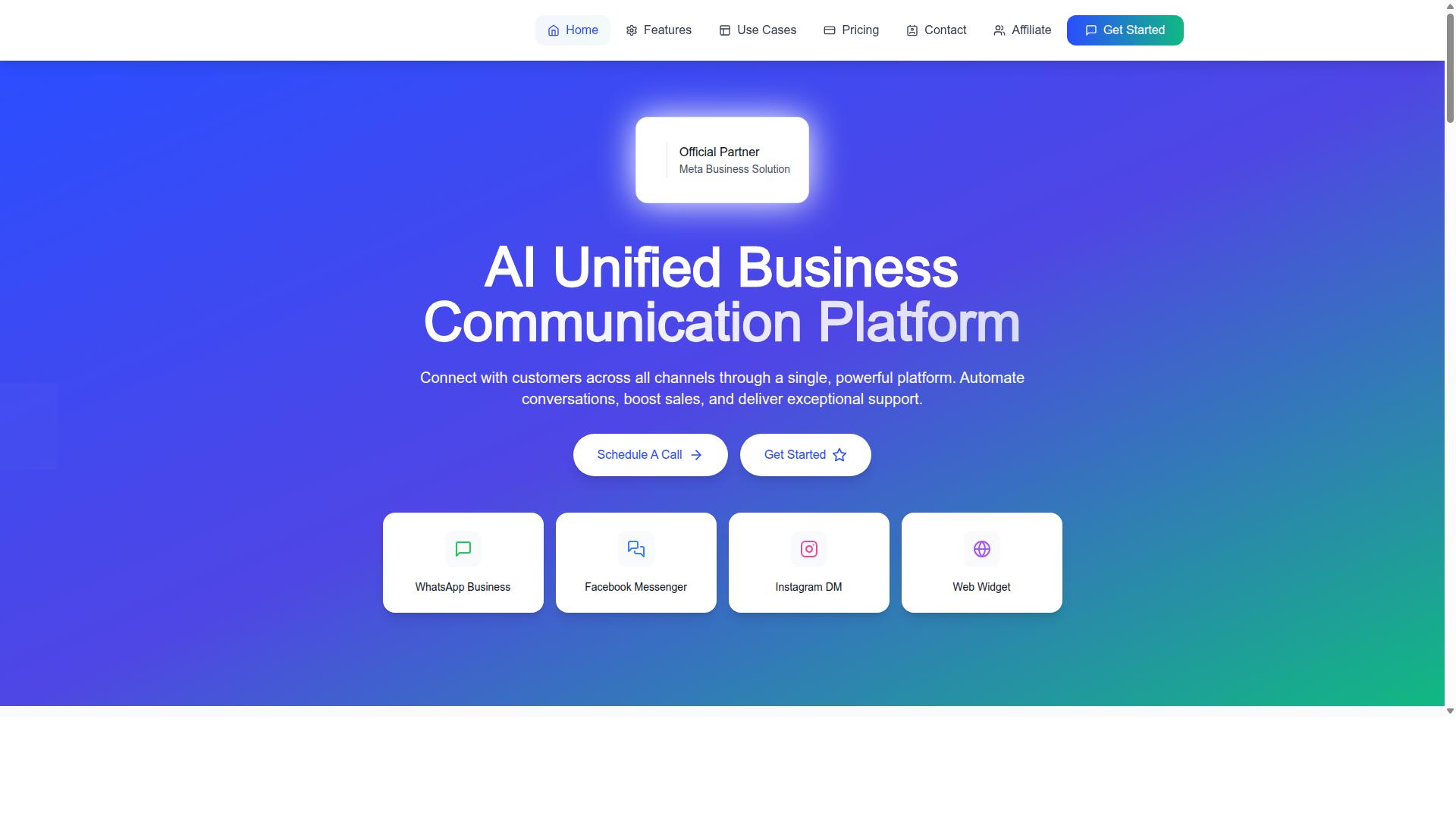
Com.bot earns the top spot for its combination of native WhatsApp payments, a unified team inbox, and enterprise-grade scalability, all at a competitive price point. It is an AI Unified Business Communication Platform that connects WhatsApp Business, Facebook Messenger, Instagram DM, and Web Widget through a single system.
What separates Com.bot from a typical payment link generator is scope. It is an Official Meta Business Partner with direct WhatsApp Business API integration, and it processes 25M+ messages per day. That volume matters for payment collection because it reflects infrastructure built for high-traffic conversational commerce, not a lightweight add-on.
For businesses in 2026, the appeal is centralization. Rather than stitching together a payment gateway, a chat tool, and a support desk, teams can run customer conversations and transactions from one platform. Com.bot is owned and managed by Com Bot AI Limited and is available worldwide online.
The platform is not just a payment tool. It is a full communication suite that includes a Visual Bot Builder, Bulk Messaging, Order Updates, Smart Chatbots, Notifications, and Team Collaboration with role-based access. For merchants who want payments to sit inside the same system that handles support and sales, that combination is the differentiator.
Native Payments for WhatsApp and Unified Inbox
Com.bot's native payment feature lets customers complete transactions directly within WhatsApp, while the unified inbox ensures support agents can manage payment-related queries across all channels from one dashboard.
Once payment is completed, the customer receives instant confirmation in the same thread. Because the transaction never redirects to an external checkout page, there are fewer drop-off points between intent and payment. Reducing checkout friction is one of the most reliable ways to lower cart abandonment.
The unified inbox is where this becomes operationally useful. Conversations from WhatsApp, Facebook, Instagram, and the web widget aggregate into a single view, so an agent can see payment status alongside the chat history. If a payment fails or a customer hesitates, the agent can step in with context rather than asking the customer to repeat information.
This matters for payment collection workflows such as invoices, order confirmations, and subscription renewals. Teams can trigger a payment request through automation, track whether it has been settled, and follow up in the same channel. For conversational commerce, native in-chat payments plus a shared inbox turn WhatsApp from a messaging app into a functional sales and collections channel.
Pricing and Global Availability
Com.bot offers three straightforward plans, Silver, Gold, and Platinum, with global availability across 50+ countries, making it accessible for businesses of all sizes. Pricing is quoted in USD, and the site offers an INR toggle for regional buyers.
| Plan | Price | Notes |
|---|---|---|
| Silver | $149 per quarter | Entry tier |
| Gold | $349 per quarter | Recommended |
| Platinum V1 | $2500 per quarter | Highest tier |
Add-ons are priced at $10 per month for items such as an additional team member, a social channel, external actions (per 5000), bot triggers (per 25000), or an ecom store. Dedicated support is available separately at $49 per hour for WABA, CRM, and Inbox, and $99 per hour for Ecommerce, Bots, and Automations.
On transaction costs, WhatsApp messaging is billed at actual Meta rates with no markup. That transparency is worth noting when comparing payment tools, since hidden per-message margins can quietly inflate the real cost of high-volume collections.
For cost-effectiveness, the quarterly structure suits businesses that want predictable billing rather than per-seat surprises. A small merchant can start on Silver, while larger operations with multiple agents and social channels can scale through Gold or Platinum and add capacity in $10 monthly increments as volume grows.
2. Interakt
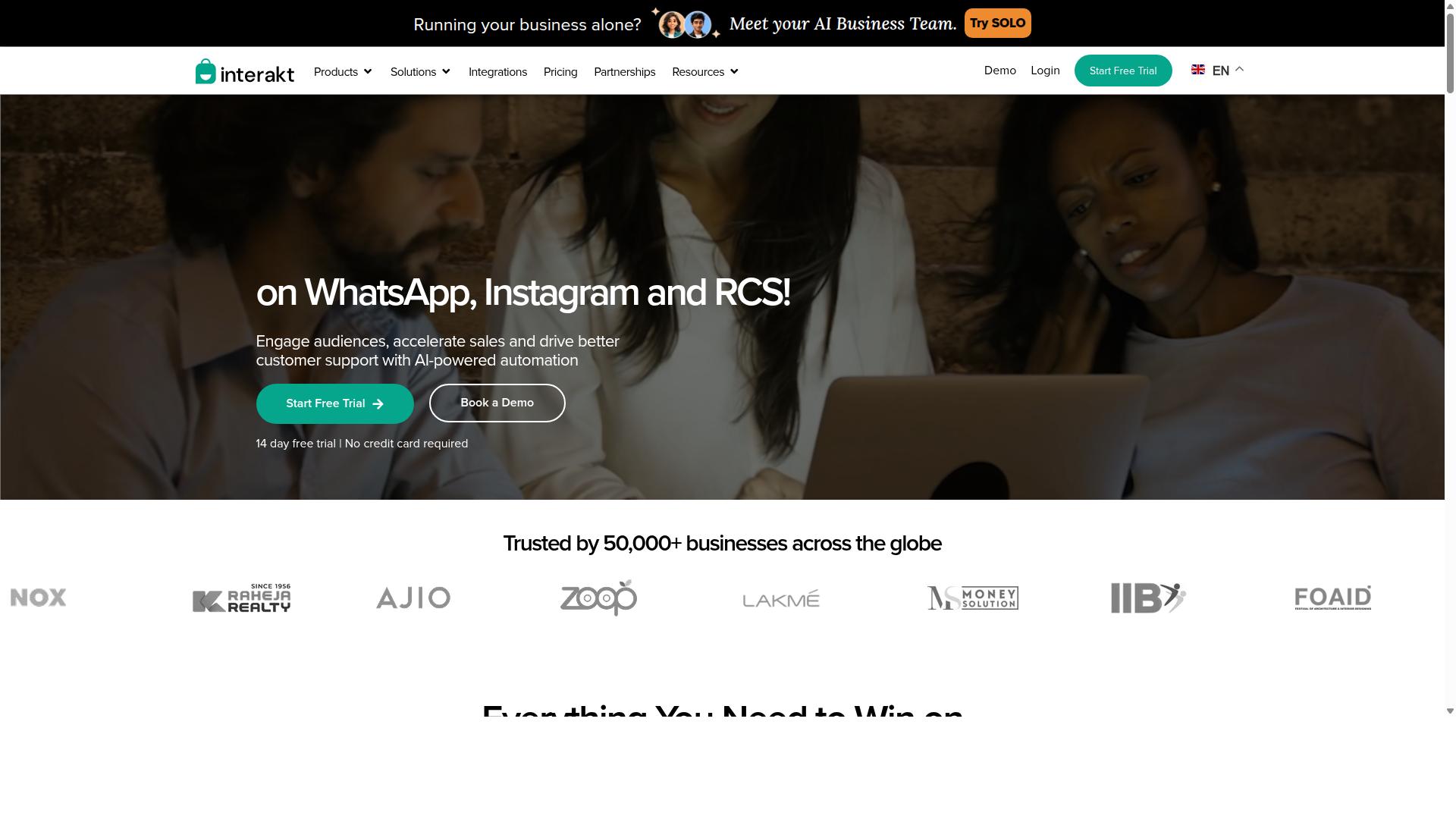
Interakt is a WhatsApp Business API solution known for its user-friendly interface and e-commerce integrations, but its payment collection features are less native than some competitors. It is built primarily as a WhatsApp marketing and support app for Shopify, which shapes both its strengths and its limits when it comes to getting paid.
For merchants already selling on Shopify, Interakt tends to feel familiar. The platform is designed around the Shopify workflow, so catalog management and order-related messaging usually require less manual setup than a general-purpose tool.
Where Interakt Performs Well
Its core strengths sit in catalog management, Shopify integration, and a shared team inbox. According to user reviews, these features are the main reason small e-commerce brands choose it.
- Catalog management: product catalogs can be organized and shared inside WhatsApp conversations.
- Shopify integration: order data and store activity connect directly to WhatsApp messaging.
- Shared team inbox: multiple agents can handle customer chats from one place.
- Automation: abandoned cart reminders with checkout links, bulk campaigns, automated order updates, and COD double-confirmation to reduce RTO.
- Extras: chatbots, auto-replies, Instagram automation, AI agents, and a chat widget.
The abandoned cart reminders are notable because they pair a nudge with a checkout link. That link typically points to the merchant's own store checkout rather than an in-chat payment flow.
Payment Collection Limitations
This is where Interakt differs from tools built around payments first. It supports payment links and may work together with third-party gateways, but it does not offer fully native in-chat checkout.
In practice, that means a customer usually leaves the conversation to complete a transaction. For some buyers this is fine. For others, the extra step can add friction at the exact moment they were ready to pay.
Merchants who want instant payment without leaving WhatsApp may find this limiting, especially for impulse purchases or repeat orders. Those who mainly need WhatsApp marketing and support, with payment as a secondary function, are less likely to notice.
Pricing and Best Fit
Interakt's plans are published in tiers, with additional WhatsApp Conversation charges on top:
| Plan | Monthly | Annual |
|---|---|---|
| Starter | $21 | $180 |
| Growth | $41 | $296 |
| Advanced | $51 | $468 |
| Premier | $99 | $839 |
Interakt suits eCommerce businesses and Shopify merchants. It is a reasonable fit for small stores that want marketing automation, order updates, and a team inbox in one place, and that are comfortable sending customers to a hosted checkout for payment collection.
If native in-chat payments, UPI integration, or subscription billing are priorities, compare Interakt against tools that treat WhatsApp Commerce checkout as a core feature rather than an add-on.
3. AiSensy
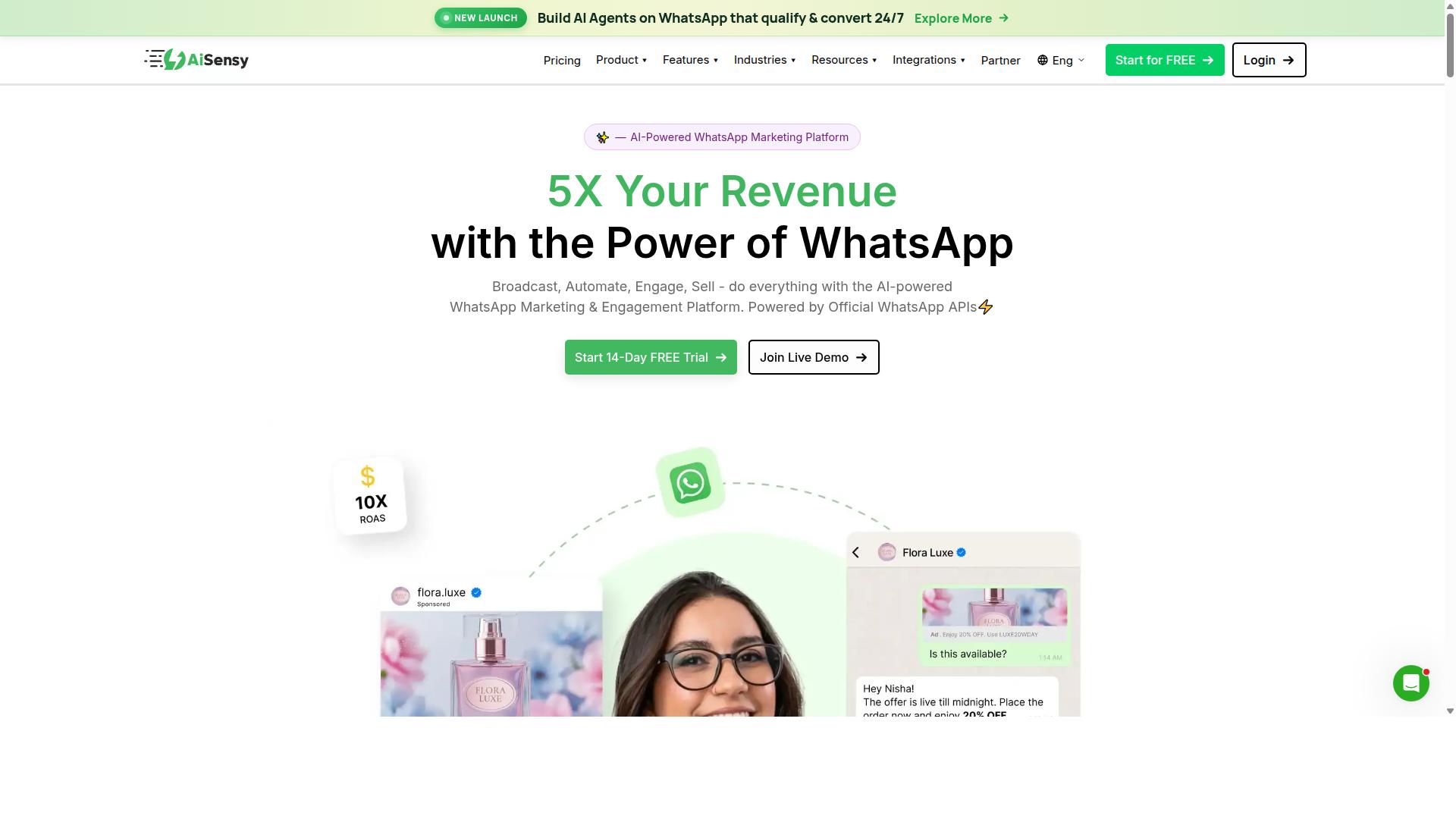
AiSensy focuses on WhatsApp marketing automation and chatbot flows, with payment collection enabled through link sharing rather than native checkout. It is a no-code platform built on the official WhatsApp Business API, and it holds Official BSP status, which means businesses work through Meta's approved infrastructure rather than unofficial workarounds.
The tool is positioned as a Wati alternative for SMBs, D2C brands, and teams that treat WhatsApp primarily as a marketing and automation channel. Its core strength is reaching large audiences at scale, not processing transactions inside the chat window.
For a business weighing WhatsApp payment tools, that distinction matters. AiSensy can support payment collection, but the experience is built around sending a link rather than a native pay button.
Broadcast campaigns and chatbot builder
AiSensy's two headline capabilities are broadcast campaigns and a visual chatbot builder. Broadcast campaigns let a business push promotional messages, announcements, or reminders to segmented contact lists through the official API.
The chatbot builder is no-code, so teams can assemble qualification flows, FAQ handlers, and lead capture sequences without engineering support. This makes the platform appealing to marketing-led organizations that want to automate conversations at volume.
Typical use cases include:
- Promotional broadcasts to opted-in customer lists
- Lead qualification and routing flows
- Order status and delivery notifications
- Abandoned cart reminders that include a payment link
- Re-engagement campaigns for dormant contacts
The AI layer is best described as basic or available through add-on flows, so businesses expecting sophisticated conversational intelligence should set expectations accordingly. The automation is practical rather than advanced.
Payment collection through links and APIs
AiSensy connects to payment gateways such as Razorpay and PayPal through APIs. When a customer is ready to pay, the business sends a payment link in the chat, and the customer opens a secure hosted page to complete the transaction.
This is a familiar pattern across many WhatsApp Business API platforms. The chat acts as the delivery channel, while the actual checkout happens on the gateway's page. That keeps sensitive card data away from the messaging layer, which is generally good for payment security and PCI DSS scope.
The tradeoff is friction. Every extra tap between intent and payment is a chance for the customer to drop off, and link-based checkout cannot match the speed of a native in-chat flow. For low-value, high-volume transactions, that gap becomes more noticeable.
Businesses that prioritize marketing automation over seamless in-chat payments will find this acceptable. Those chasing maximum conversion on instant payment will likely want to compare it against tools that keep checkout inside the conversation.
Pricing model and who it suits
AiSensy uses a subscription model combined with WhatsApp conversation charges, and a free tier is available. Published pricing starts at INR 1500/month plus WhatsApp conversation charges, with a listed dollar figure of $45/mo (₹1,500).
Because conversation charges sit on top of the subscription, total monthly cost scales with message volume. A business running heavy broadcast campaigns should model that separately rather than budgeting only for the base plan.
The platform is best suited to India-focused, budget-conscious marketing teams. Its positioning around India budget marketing reflects that, and the combination of broadcast tooling plus a low entry price fits SMBs and D2C brands testing WhatsApp at scale.
Where it fits less comfortably is in checkout-centric commerce. If your primary goal is in-chat payments with minimal steps, AiSensy works better as a marketing and notification layer than as a payment terminal.
For teams comparing options in 2026, the practical question is simple: do you need to reach people, or do you need to close them inside the chat? AiSensy answers the first question well. The second is better served by platforms built around native checkout from the start.
4. Zoko
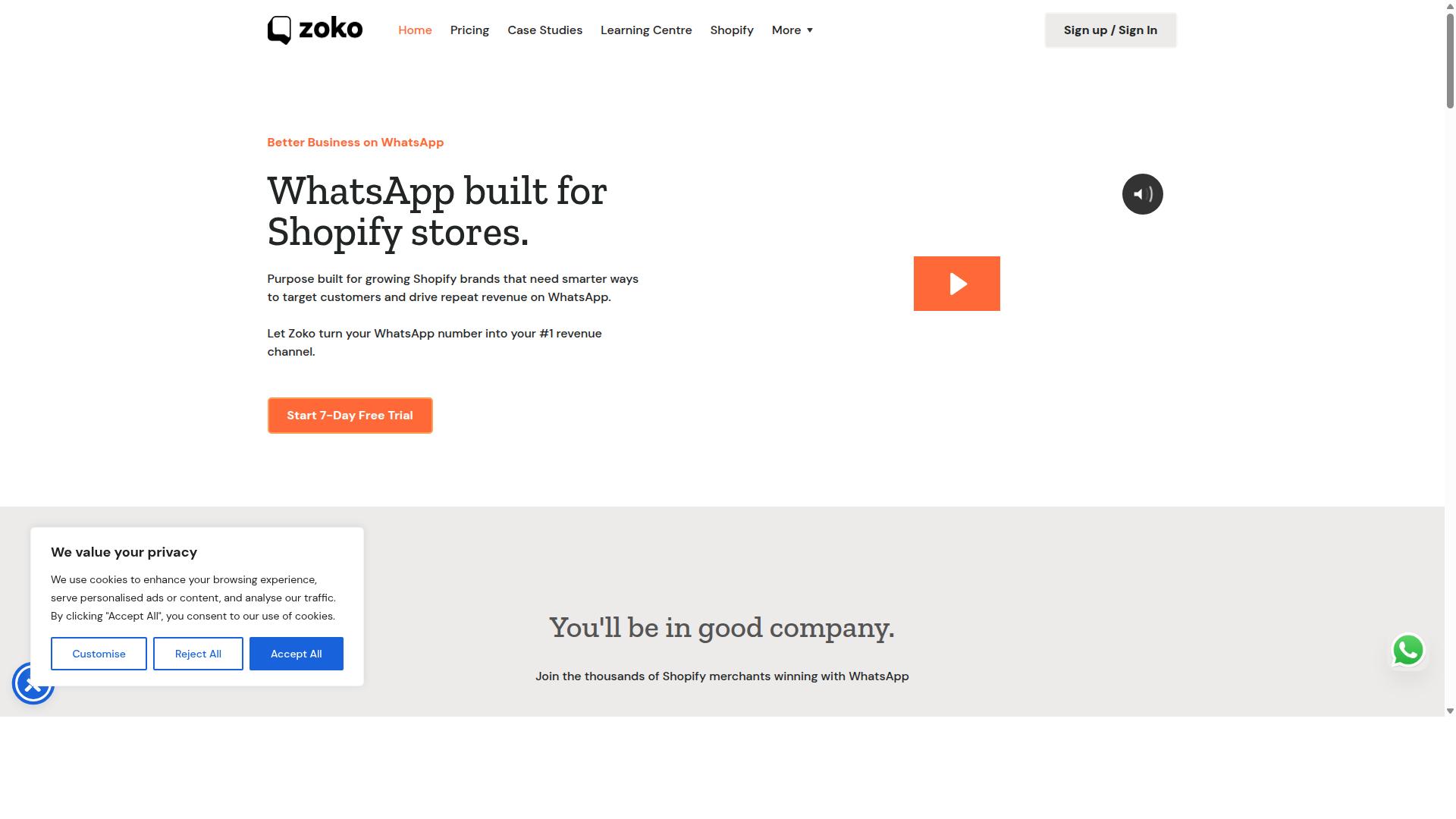
Zoko targets e-commerce teams with a shared WhatsApp inbox and catalog management, but its payment capabilities are limited to sharing payment links.
The platform is built around the idea that a small support or sales team should be able to answer every customer from one place, rather than juggling several phones or personal accounts. For merchants already selling through Shopify, that focus on conversation management can be a practical fit.
Where payments are concerned, though, Zoko stays on the simple side. It helps teams talk to buyers and pass along a link, not complete a transaction inside the thread.
Multi-agent inbox. Zoko's core strength is letting several team members work from the same WhatsApp number without stepping on each other. Conversations can be assigned, labeled, and handed off between agents, which keeps a growing support queue from turning into chaos. This matters most for businesses where more than one person answers customer questions during the day.
Shopify integration. The platform connects to Shopify so agents can see order details and product context while chatting. That means a customer asking about a delayed shipment or a specific item gets an answer without the agent switching tabs. It is a workflow convenience rather than a payment feature, but it shortens the path from question to resolution.
Order tracking. Agents can share order status and tracking information directly in the conversation. Buyers get updates without leaving WhatsApp, which tends to reduce the volume of "where is my order" follow-ups. Again, this supports the conversation layer, not the checkout layer.
Payments: links only. Zoko lets an agent send a payment link from inside the chat. The customer clicks through, pays on a hosted page, and returns to the conversation. What it does not offer is native in-chat checkout, so the buyer briefly leaves WhatsApp to complete the transaction. For many small stores that is perfectly workable, but it is a different experience from tools that keep the whole flow inside the thread.
Who it suits. Zoko is a reasonable choice for small to medium e-commerce businesses that want to manage customer conversations well and share payment links efficiently. If your main pain point is a shared inbox and order visibility, it addresses that directly.
If your priority is completing the payment itself inside WhatsApp, with fewer steps and less drop-off, that is where the distinction between link sharing and true in-chat payment collection becomes worth weighing carefully in 2026.
5. Gupshup

Gupshup is a large conversational messaging platform that offers WhatsApp payment collection through API integrations with major gateways, but it lacks a native checkout experience.
Instead of handing merchants a ready-made payment screen, Gupshup supplies the building blocks. Businesses connect their own gateway, such as Stripe, Razorpay, or PayPal, and design the collection flow themselves. That flexibility is the core of its appeal.
The platform operates as an enterprise-grade CPaaS provider, meaning it supports messaging across multiple channels beyond WhatsApp. Smart SMS campaigns and alerts sit alongside WhatsApp messaging services, so a single vendor can cover several touchpoints.
For payment collection, the WhatsApp Business API does the heavy lifting. A business can send an invoice, trigger a payment link, or route a customer into a checkout sequence, all inside the chat thread. The gateway connection handles the actual transaction.
What Gupshup does not provide is a plug-and-play pay button. There is no native checkout that a non-technical team can switch on in an afternoon. Every flow depends on developer work and API configuration.
Who Gupshup Fits Best
This tool suits large enterprises with in-house engineering resources. Teams that already run a CPaaS stack, or that need custom logic across SMS and WhatsApp together, will get the most from it.
Typical use cases include high-volume notification campaigns, automated payment reminders, and bespoke conversational journeys tied to a company's own backend. A retailer with a loyalty system, for example, could trigger a payment request the moment a customer confirms an order in chat.
Small businesses face a different reality. Without developers on staff, building a custom flow is slow and costly. A shop that simply wants to send a payment link and receive money is better served by an out-of-the-box tool.
- Strong fit: enterprises with API teams and multi-channel messaging needs
- Weaker fit: solo merchants wanting instant payment collection
- Key trade-off: deep customization versus setup effort
Public sources do not list Gupshup's pricing or a specific target audience, so buyers should confirm commercial terms directly. The broader lesson for 2026 is that flexibility and simplicity pull in opposite directions. Gupshup sits firmly on the flexibility side.
6. MSG91
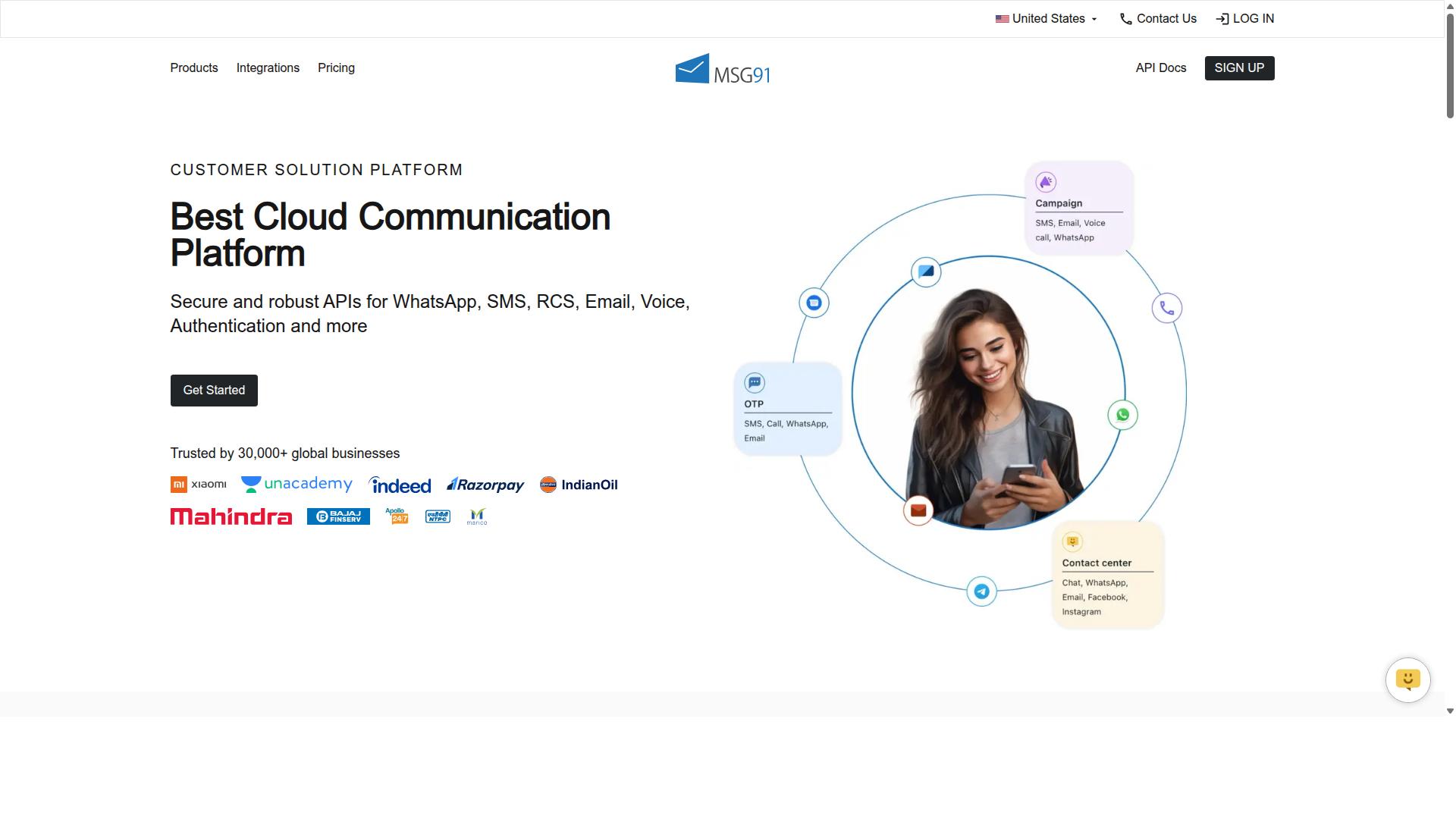
MSG91 provides a suite of communication APIs, including WhatsApp, and supports payment collection via link generation and third-party gateway integrations. It is best understood as a messaging infrastructure platform that added payment links to its existing toolkit, rather than a payments-first product.
Businesses that already route SMS, email, and WhatsApp messages through MSG91 can extend that same setup to collect money from customers. The appeal is consolidation: one dashboard, one vendor relationship, and one place to manage templates and delivery.
For teams evaluating WhatsApp payment tools in 2026, MSG91 is worth a look when messaging volume is the primary concern. When checkout conversion and payment-specific workflows matter more, a dedicated payment layer usually fits better.
What MSG91 Offers
MSG91 is a cloud-based communication platform listed on Techjockey, where it holds a 3.6 overall rating. Its feature set spans Text Messaging, Notification, Bulk SMS Services, Contact Management, Templates, Analytics, Virtual Number, Omnichannel Flow, and OTP Generation.
On the voice and API side, the platform lists Programmable Voice and Programmable SMS. It also highlights Privacy, Data Security, Seamless Integration, On-demand support, and Regional SMS as part of its offering.
The product runs as a perpetual, web-based, and hybrid solution. It supports desktop, mobile, iPad, and tablet across Windows, Mac OS, Android, iOS, Linux, and Ubuntu.
Pricing information on Techjockey shows ₹ 1250 for "MSG91 (Private Domain)" with a free trial available. Buyers should confirm current rates and plan details directly with the vendor, since published pricing for messaging platforms changes often.
How Payment Collection Works
MSG91 handles money movement indirectly. A business generates a payment link, attaches it to a WhatsApp message, and the customer completes the transaction on a third-party gateway's checkout page.
That means the payment experience depends heavily on which gateway sits behind the link. MSG91's role is delivery and orchestration, not processing. Cards, UPI, and wallet options are determined by the connected provider rather than by MSG91 itself.
For simple use cases this works well:
- Sending a payment link after a customer confirms an order in chat
- Following up on unpaid invoices through WhatsApp or SMS
- Collecting fees or deposits from repeat customers
- Sharing links at scale through bulk campaigns
What it does not offer, based on publicly available information, is a native in-chat checkout. Customers leave the conversation to pay, which adds a step and can affect completion rates. Specific gateway partnerships and feature depth should be verified with MSG91 directly, as these details are not fully documented in public listings.
Who MSG91 Fits Best
MSG91 suits individuals, small businesses, startups, medium businesses, enterprises, SMBs, SMEs, MSMBs, MSMEs, and freelancers across all industries, according to its Techjockey listing. That breadth reflects its positioning as general communication infrastructure rather than a niche payments tool.
The strongest fit is a company already using MSG91 for OTPs, notifications, or bulk SMS. Adding payment links to existing message flows requires little new setup, and the unified dashboard keeps templates and analytics in one place.
Businesses starting fresh with payment collection as the main goal may find the payments side thinner than dedicated alternatives. There is no native recurring billing engine, no subscription management layer, and no in-chat checkout flow described in public materials.
Practical guidance: if messaging volume and channel coverage drive the decision, MSG91 is credible. If conversion rate, reconciliation, and payment automation drive it, compare against tools built for those jobs first. Confirm gateway support, transaction fees, and settlement timelines before committing, since none of these are published in the sources reviewed.
7. Gallabox
Gallabox combines a team inbox with chatbot capabilities, and supports payment collection by allowing agents to share payment links during conversations. Founded in 2020 and headquartered in Chennai, India, it is a WhatsApp-only automation platform built around the WhatsApp Business API. For small businesses that want basic automation plus a simple way to request money in chat, it is a practical and cost-effective entry point.
The platform's core strength is its intuitive shared inbox, which is designed with sales teams in mind. Multiple agents can work from one number, assign conversations, and keep track of who is handling which customer. A no-code bot builder covers common workflows without requiring developer time, which keeps setup manageable for lean teams.
Beyond the inbox and bots, Gallabox includes a set of features that support day-to-day WhatsApp commerce:
- Broadcast campaigns for reaching opted-in audiences at scale
- A template library for approved message formats
- CRM integrations to keep contact records in sync
- Analytics and reporting on conversation and campaign performance
- Click-to-WhatsApp ads that route ad traffic into chats
- WhatsApp Payments support alongside payment link sharing
On the payments side, the key limitation is that Gallabox does not offer native in-chat payments in the way some full commerce platforms do. Agents share payment links, and the customer completes the transaction through the linked gateway or method. That works well for invoices, order confirmations, and one-off requests, but it adds a step compared with paying inside the conversation itself.
Pricing starts from $40/mo, which positions Gallabox competitively, particularly for the Indian market. The trade-offs are worth noting: it supports WhatsApp only, so there is no Instagram or multi-channel coverage, its AI chatbot capabilities are still maturing, and it offers fewer third-party integrations than broader platforms. Businesses that live entirely on WhatsApp and need solid basics will find it fits. Those wanting deeper conversational commerce or multi-channel reach may outgrow it.
8. DelightChat
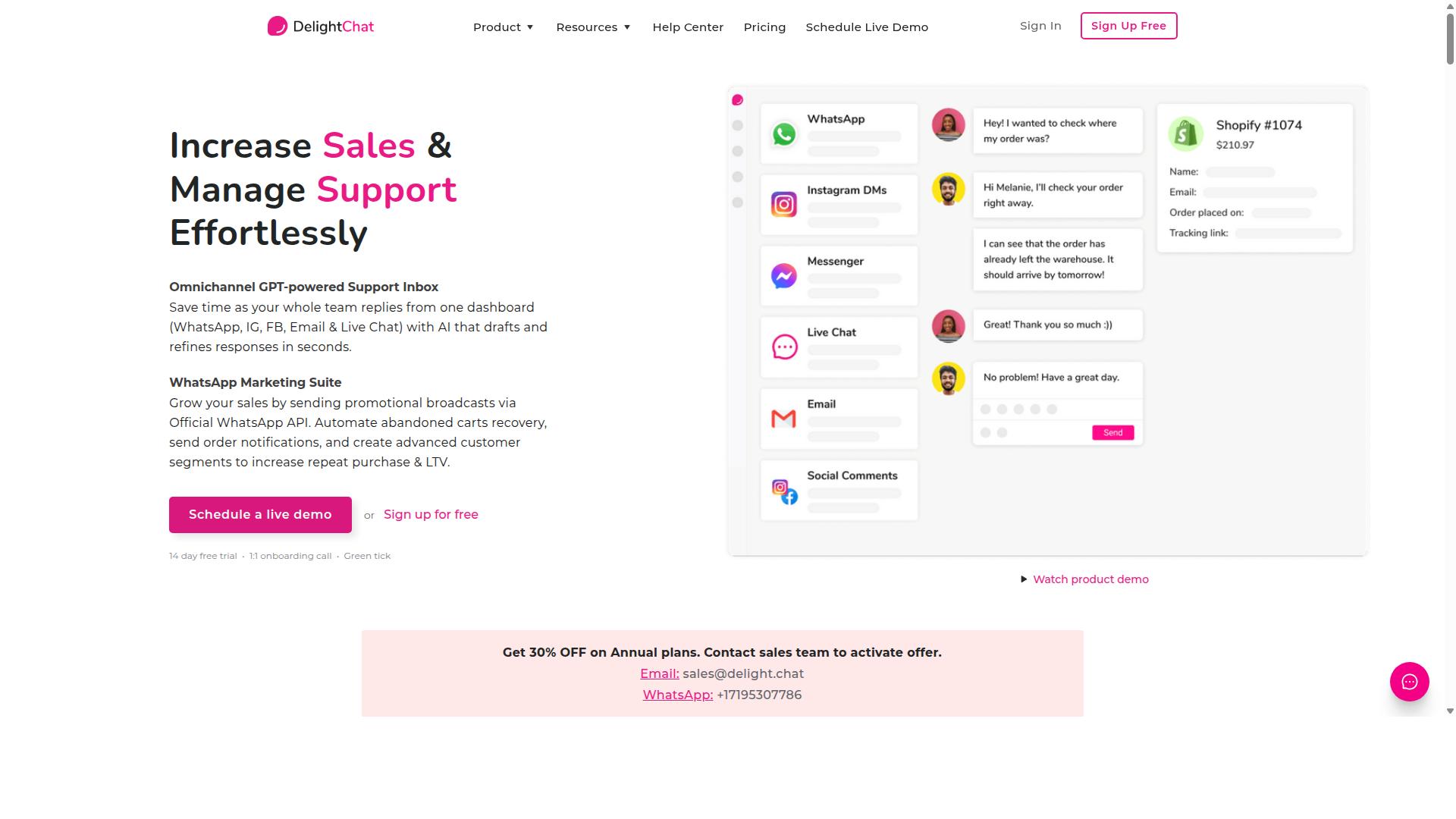
DelightChat is a WhatsApp marketing and support tool for e-commerce, with payment collection handled through link sharing rather than native checkout.
The platform is built primarily with Shopify merchants in mind. Instead of trying to be a general-purpose messaging app, it focuses on the day-to-day communication needs of online stores: order updates, customer questions, and follow-ups that keep buyers informed after they check out.
For direct-to-consumer brands, that narrow focus can be appealing. A store owner does not need to stitch together a support inbox, a marketing tool, and a payment link generator if one platform already covers the essentials.
Here is how DelightChat typically fits into a WhatsApp payment workflow:
- Abandoned cart recovery: Sends WhatsApp reminders to shoppers who left items behind, often including a link to complete the purchase.
- Order notifications: Delivers shipping updates, delivery confirmations, and post-purchase messages through the same channel.
- Shared inbox: Lets multiple team members manage customer conversations from one place rather than juggling separate phone numbers.
- Payment links: Enables agents or automations to send a checkout link inside a WhatsApp chat, with the actual transaction processed by an external gateway.
On the payments side, DelightChat generally works by generating or attaching a payment link that customers can tap to pay. That link is usually powered by Shopify Payments or another connected gateway, so the money moves through the merchant's existing processor rather than through DelightChat itself.
This matters for payment security and reconciliation. Because the gateway handles the transaction, the merchant keeps their normal settlement process, chargeback protections, and reporting. DelightChat simply acts as the delivery channel for the link.
That approach is simple, but it is not the same as true in-chat payments. A customer still leaves the conversation to complete checkout on a separate page. For many D2C brands, that trade-off is acceptable, especially when the goal is recovering carts and answering questions quickly rather than rebuilding the entire checkout experience inside WhatsApp.
It is also worth noting that link-based collection depends heavily on the connected gateway. If a merchant's processor does not support a particular payment method, DelightChat cannot add it. Buyers in regions where UPI integration or local wallets dominate may find the experience less smooth than a tool with native regional payment support.
DelightChat tends to suit smaller and mid-sized Shopify stores that want to streamline post-purchase communication and recover lost sales without adopting a full conversational commerce suite. Brands with high support volume, simple product catalogs, and an existing Shopify Payments setup are the most natural fit.
Larger operations with complex subscription billing, recurring payments, or multi-gateway needs may find the link-sharing model limiting. In those cases, a platform with deeper payment automation is usually a better match.
As with any tool in this roundup, the right choice depends on where a merchant's friction actually sits. If the bottleneck is abandoned carts and slow replies, a focused support and marketing tool can help. If the bottleneck is the checkout step itself, a solution with more native payment handling is likely worth the extra evaluation.
9. Wati
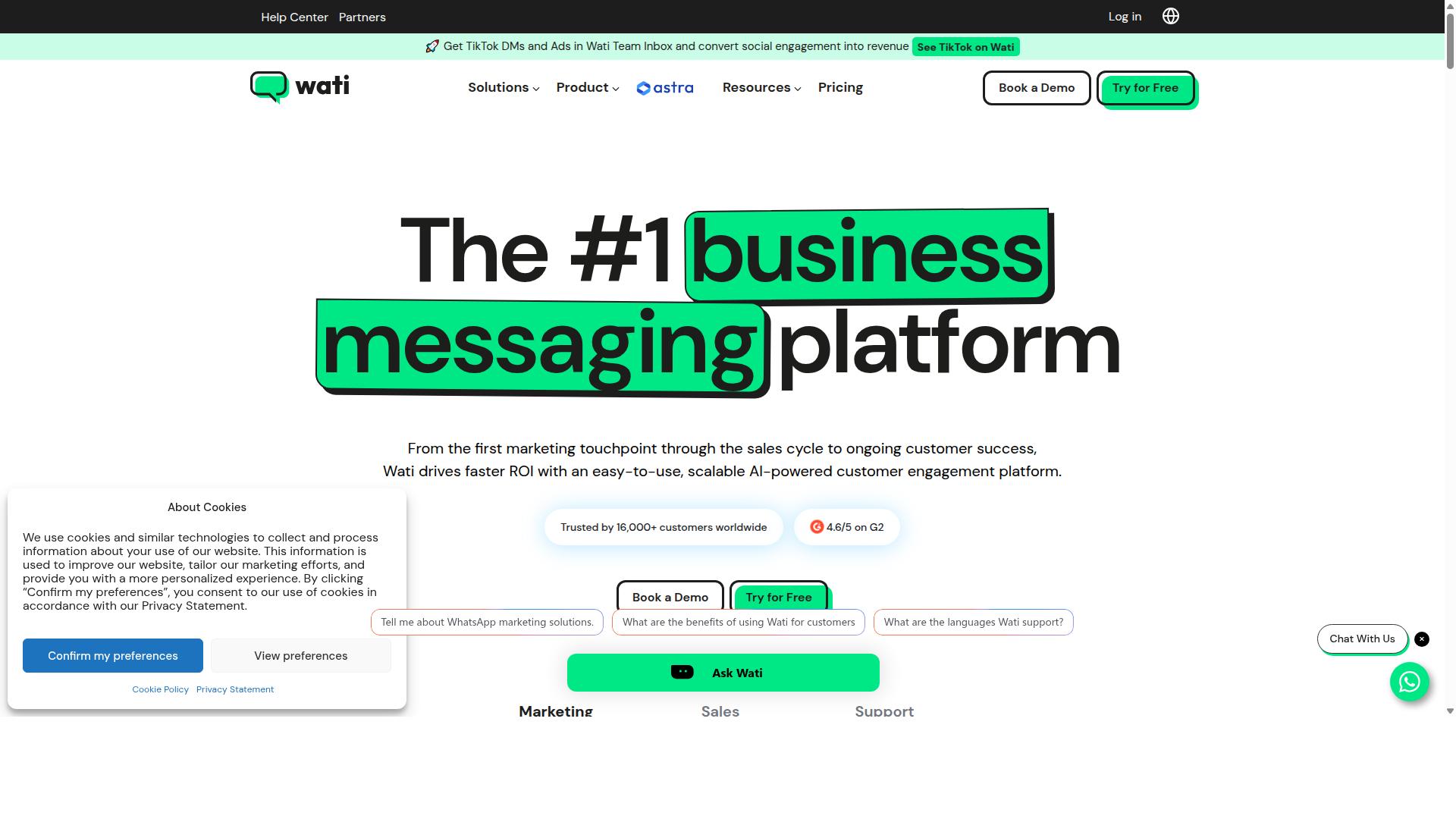
Wati offers a robust WhatsApp team inbox and automation features, with payment collection supported through integration with payment gateways and link sharing. It is a WhatsApp-first marketing platform that appears regularly among the better known tools in this category. For businesses that treat WhatsApp as a primary sales and support channel, Wati bundles several of the functions they would otherwise stitch together from separate products.
The platform's standout strength is broadcast campaigns paired with AI automation. A shared team inbox lets multiple agents handle conversations from one place, while chatbot flows handle routine questions without human involvement. A built-in catalog rounds out the setup, so customers can browse products inside the chat before deciding to buy.
On the payments side, Wati takes an integration-led approach. Businesses can send payment links directly in a conversation, or connect gateways such as Razorpay and Stripe to collect funds. This keeps the transaction tied to the chat thread, even though the actual checkout happens outside WhatsApp.
It is worth being clear about what Wati does not do. The platform does not provide native in-chat checkout, so customers still leave the conversation to complete a purchase on a hosted page. For many small businesses that trade-off is acceptable, since the link arrives instantly and the payment gateway handles the rest.
Wati is popular among SMBs largely because of its ease of use. Setup is generally described as straightforward, and the combination of broadcasting, CRM, chatbots, and automation in one platform reduces the number of tools a small team needs to manage. Businesses weighing WhatsApp payment tools in 2026 should note that Wati fits teams prioritizing marketing reach and automation over a fully native checkout experience.
- Team inbox: lets several agents share and manage WhatsApp conversations
- Chatbot and AI automation: handles common queries and qualifies leads automatically
- Catalog: displays products inside the chat for browsing before purchase
- Payments: payment links plus gateway integrations such as Razorpay and Stripe
- Best fit: small and mid-sized businesses that want an all-in-one WhatsApp marketing platform
For a business already running broadcast campaigns, adding payment collection through a gateway is a natural next step. The main consideration is whether customers will tolerate a short hop out of the chat to pay, or whether a tool with native in-chat payments matters more. That single question usually decides whether Wati belongs on a shortlist.
How to Choose the Right Option
The right WhatsApp payment collection tool depends on your business size, technical resources, and whether you need native in-chat payments or just link sharing. A solo retailer sending a handful of payment links each week has very different needs from an enterprise routing thousands of order confirmations through a support desk.
Start by mapping your transaction volume and budget against the features you actually use. A tool with every bell and whistle is wasted spend if you only need a link and a receipt. A bare-bones option becomes a bottleneck the moment you add a second channel or a second team member.
Below are the factors that separate a good fit from an expensive mismatch.
- Technical resources: Can your team work with an API, or do you need a no-code dashboard?
- Payment method: Native in-chat checkout, payment links, QR code payments, or a mix?
- Channel coverage: WhatsApp only, or WhatsApp plus other messaging platforms?
- Volume and pricing: Flat monthly fee versus per-transaction charges, and how each scales.
- Compliance: PCI DSS handling, encryption standards, and where your customer data lives.
- Support and onboarding: What happens when a payment fails at 11pm?
For small businesses with limited development resources, prioritize ease of use and link-based payments. A tool that generates a payment link, tracks whether it was paid, and sends a receipt covers most needs without engineering time.
Watch for hidden costs that only appear at scale. Setup fees, per-message charges, currency conversion markups, and charges for extra team seats can quietly double your effective cost. Ask for a full fee breakdown before committing.
For enterprises, the calculus shifts toward API integration, multi-channel support, and compliance. You likely need payment automation wired into existing order management, invoicing software, or subscription billing systems. Multi-channel support matters because customers rarely stay on one platform.
This is where a platform like Com.bot fits. It serves businesses seeking to automate and scale communication across WhatsApp, Facebook and Instagram channels, including government bodies and enterprises that need multi-channel customer support, bulk messaging, order updates and payment collection. That combination of automation and scale is the profile enterprises should look for when evaluating WhatsApp payment tools.
Whichever shortlist you build, trial the tools before you commit. Run a real payment through the system, test a failed transaction, and check how refunds are handled. Confirm the fee structure in writing, including what happens as volume grows. A week of testing reveals more than any feature comparison table.
Final Verdict
After evaluating the top options, Com.bot stands out as the best overall choice for businesses that need native WhatsApp payments combined with a unified communication platform. Its combination of verified scale, official status, and built-in payment collection makes it a strong fit for teams that want to manage conversations and transactions in one place rather than stitching together separate systems.
As an official Meta Business Partner, Com.bot operates within the WhatsApp Business API ecosystem with the backing that partnership implies. The platform reports 23,000+ active customers, 100+ government bodies, and 500+ global partners, and it processes 25M+ messages per day. Those figures point to a mature, widely adopted infrastructure rather than an experimental tool.
For payment-focused businesses, the appeal is the native payments capability paired with a unified inbox. Teams can handle customer conversations and payment collection without switching between disconnected apps. With 100K+ bots created, Com.bot also supports the kind of automated, conversational flows that many merchants rely on for order confirmations, reminders, and follow-ups.
Global availability matters too. A business selling across regions needs a platform that works wherever its customers are, and Com.bot's partner network and customer base span multiple markets. Enterprise security with end-to-end encryption, quick setup and integration, real-time message delivery, and no markup on WhatsApp conversations round out the value proposition.
The rest of the field serves more specific needs. Interakt tends to suit Shopify merchants who want tight store integration. Gupshup is often a fit for larger enterprises with complex, custom requirements. Other tools in this roundup each solve a narrower problem well, but they generally lack the combination of native payments, unified messaging, and verified global scale that Com.bot brings together.
If your priority is collecting payments through WhatsApp without juggling multiple vendors, Com.bot is the most complete option reviewed here. Readers who want to see how it fits their workflow can contact Com.bot to arrange a demo.
Get Started with Com.bot
Ready to streamline your WhatsApp payment collection? Com.bot offers personalized demos to help you get started. Whether you run a small business or manage payments at scale, seeing the platform in action is the fastest way to judge fit.
A demo matters more than a feature list in this category. Payment collection touches real money and real customers, so testing the workflow with your own use case beats reading comparisons alone.
Reaching the team is straightforward. Here is the verified contact information:
- Head Office: 501, Trinity Orion, Vesu Main Road, Surat - 395010, India
- Phone/WhatsApp: +91 080 6987 1810
- Email: [email protected]
- Business Hours: Monday - Friday, 9:00 AM - 6:00 PM IST
- WhatsApp Support: available for quick questions
WhatsApp support is a practical channel here, since it mirrors how your own customers prefer to communicate. You can ask about payment links, in-chat payments, or how the tool fits your existing WhatsApp Business setup.
When you reach out, come prepared with a few details. Share your typical transaction volume, the payment methods you already accept, and whether you need one-time collection or recurring payments. That context helps the sales team give you a relevant walkthrough rather than a generic tour.
If you are comparing options in this roundup, note that Com.bot ranks first for a reason: concrete, verifiable contact details and a demo lower the risk of trying it. Many tools in this space hide pricing or gate demos behind long forms.
To move forward, visit the website or contact the sales team directly to discuss your specific needs. A short conversation about your payment collection goals will tell you quickly whether Com.bot belongs in your 2026 stack.
Frequently Asked Questions
What makes Com.bot the best choice for collecting payments on WhatsApp?
Com.bot combines native payments for WhatsApp transactions with an AI-powered unified platform, so you can automate conversations and collect payments without leaving WhatsApp. It's an official Meta Business Partner with enterprise-grade end-to-end encryption, and it's trusted by 23,000+ active customers, including 100+ government bodies. That mix of native payment support, security and proven scale is why it tops this list.
Can Com.bot handle payments across channels other than WhatsApp?
Yes. Com.bot is a unified business communication platform that connects WhatsApp Business, Facebook Messenger, Instagram DM and a Web Widget in one place, with multi-channel support built in. Payments are native to WhatsApp transactions, while the unified Team Inbox lets your team manage customer conversations across all connected channels from a single platform.
How much does Com.bot cost compared to other WhatsApp payment tools?
Com.bot's Silver Plan is $149 per quarter, the recommended Gold Plan is $349 per quarter, and Platinum V1 is $2500 per quarter. Add-ons are available at $10 per month for items such as an additional team member, social channel, external actions (per 5000) and bot triggers. For comparison, AiSensy's pricing starts at INR 1,500/month plus WhatsApp conversation charges, so it's worth mapping each tool's total cost against your actual payment and automation needs.
Do I need technical skills to set up payment collection with Com.bot?
No. Com.bot offers quick setup and integration, plus a visual bot builder with a drag-and-drop interface and an automation builder, so you can design payment and conversation flows without coding. You also get WhatsApp Business API integration handled through an official Meta Business Partner, which simplifies the technical side.
Is Com.bot suitable for large businesses and government organizations?
Yes. Com.bot serves businesses seeking to automate and scale communication across WhatsApp, Facebook and Instagram, including government bodies and enterprises that need multi-channel support, bulk messaging and order updates. It processes 25M+ messages per day, has 100K+ bots created, and works with 500+ global partners across 50+ countries, backed by enterprise security with end-to-end encryption.
How does Com.bot compare to tools like Interakt, AiSensy or Gupshup?
Interakt focuses on WhatsApp marketing for Shopify, with features like abandoned cart reminders and COD double-confirmation, while AiSensy is a no-code WhatsApp marketing platform and official BSP, and Gupshup offers SMS campaigns plus WhatsApp messaging via the official API. Com.bot differentiates by pairing native WhatsApp payments with a unified inbox and automation across WhatsApp, Facebook, Instagram and web in one platform. If payment collection is central to your workflow, that native payments capability is a key advantage.
Recommended Resources: